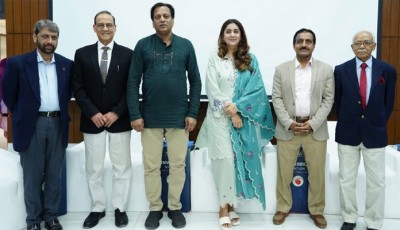

KARACHI: Dow University of Health Sciences (DUHS) has formally launched “Bug & Drug,” a locally developed Clinical Decision Support (CDS) application aimed at helping doctors make timely, evidence-based decisions in the treatment of infectious diseases while promoting the rational and responsible use of antimicrobial medicines.
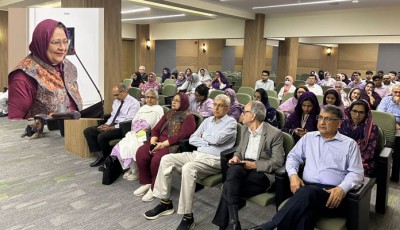
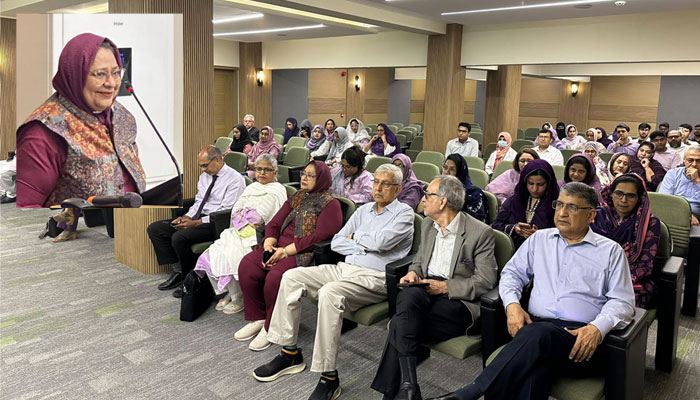
Vice Chancellor Prof. Nazli Hossain formally launched the application at a ceremony held at the auditorium of the Sindh Infectious Diseases Hospital & Research Centre (SIDH&RC), while Professor Emeritus Dr Muhammad Saeed Quraishy, former Vice Chancellor of DUHS, inaugurated its publication.
Addressing the ceremony, Prof. Nazli Hossain described the initiative as an important step towards strengthening clinical decision-making, particularly at healthcare facilities where infectious disease specialists may not be readily available.
She said the number of infectious disease specialists in Pakistan remained limited, particularly in smaller and secondary-care hospitals, and the application could provide doctors with evidence-based clinical guidance at the patient’s bedside.
Prof. Hossain said DUHS would continue supporting the project and suggested preparing a brief tutorial on the use of the application for placement on the university’s website to enable more doctors to benefit from it.
She also stressed the need to regularly update “Bug & Drug” using data from local hospitals and said its future development should examine whether it should primarily operate at individual hospital level or be expanded using city- and region-specific data.
She highlighted its potential application in conditions such as puerperal sepsis and called for exploring its usefulness in secondary-care hospitals.
Presenting an overview of the application, Dr Muneeba Ahsan Saeed said “Bug & Drug” had been designed to assist doctors in making clinical decisions according to patients’ conditions while taking Pakistan’s medical and local context into account.
“The core concept of the application is reflected in its name: identifying the right Bug and selecting the right Drug,” she said.
According to Dr Saeed, the application contains information on 113 infectious diseases, 141 etiological agents and 75 antimicrobials.
Former DUHS Vice Chancellor Prof. Muhammad Saeed Quraishy said recurrent infections represented an important clinical challenge and expressed hope that the application would be widely utilised by healthcare professionals.
Dr Muneeba Ahsan Saeed and Dr Fazza Farooqi said the application was not intended to replace medical specialists but to support healthcare professionals in making informed clinical decisions.
During a demonstration, participants were informed that the app includes Quick ID Consult and Creatinine Clearance calculators. Its NEWS2 tool assists in assessing a patient’s level of risk, while the application can support clinicians in determining the appropriate time to initiate antibiotics in cases of sepsis.
The Creatinine Clearance calculator helps clinicians determine antimicrobial dosages according to renal function.
Another feature, Culture-Guided Therapy, provides a prioritised list of potential medicines based on the site of infection, culture results, identified organism and antimicrobial susceptibility.
The Antimicrobial Resistance section provides information on resistant organisms, associated resistance genes and possible treatment options. The application also contains information about relevant healthcare centres across Pakistan to help connect HIV and tuberculosis patients with appropriate treatment facilities.
For sexually transmitted infections, the app provides guidance on symptom-based diagnosis, treatment, partner management and follow-up, while its vaccination section contains information on vaccines, schedules, administration methods and possible adverse effects.
Prof. Dr Syed Faisal Mahmood said infectious diseases represented a complex field where timely clinical decisions could be challenging because of the wide range of microorganisms, multiple antimicrobial options and individual patient factors.
He said “Bug & Drug” had been developed specifically in the Pakistani context, incorporating local organisms, diseases and available medicines while also taking international standards into consideration.
He said the application differed from internationally used resources such as the Sanford Guide because it had been designed around Pakistan’s healthcare needs and local clinical conditions. He urged healthcare professionals to use the app and provide feedback to its development team.
Dr Asma Naseem stressed the importance of creating awareness about the application among doctors, saying greater utilisation would increase its potential benefit while generating feedback and usage data for continuous improvement.
She said the application could be particularly useful in public-sector hospitals as a bedside clinical decision-support tool.
Dr Abdul Wahid Rajput said antimicrobial resistance was a major global health challenge and stressed that evidence-based clinical decision-making and responsible use of antimicrobial medicines were essential to address the problem.
Dr Izhar Hussain highlighted the need for a national antibiogram and standardised therapeutic guidelines based on local evidence and data. He said inappropriate antibiotic use was not limited to human health but also involved animals and the environment.
He also pointed to the declining pace of development of new antibiotics, saying stronger basic and applied research at universities was needed to respond to the growing challenge of antimicrobial resistance.
Speakers said “Bug & Drug” was an evolving platform that could be further expanded and updated in accordance with local antibiograms, emerging scientific evidence, clinical needs and user feedback.
The application also includes a bug-reporting system enabling users to directly report potential errors, information-related issues and suggestions to the development team.
According to the experts, the overall objective of “Bug & Drug” is to support timely, safe and evidence-based clinical decision-making in infectious diseases, promote appropriate antimicrobial use, facilitate early recognition and treatment of sepsis and strengthen efforts to combat antimicrobial resistance in Pakistan.
The ceremony was attended by specialists in infectious diseases, microbiology and medicine, as well as doctors, medical officers, researchers and members of the application development team.