
CHONGQING (Xinhua): As China’s “cyberpunk city” Chongqing experienced intense summer heat, Pakistani medical graduate Tariq Azam adopted a traditional Chinese approach to cope with the hot and humid weather.
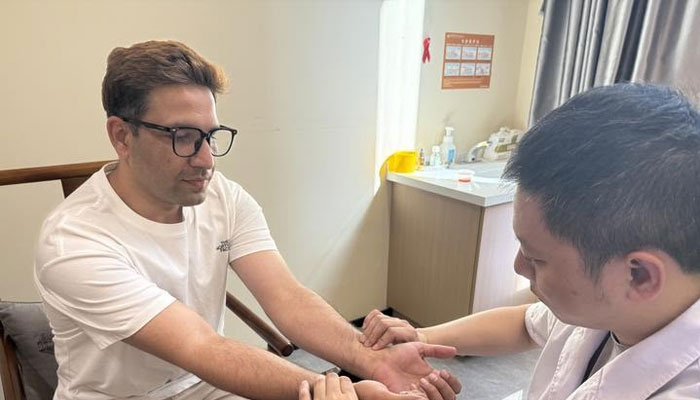
At the Traditional Chinese Medicine (TCM) clinic of the Second Affiliated Hospital of Chongqing Medical University, Tariq experienced acupuncture, moxibustion and auricular therapy. These treatments are commonly used during the hottest days of the year to help people adjust to Chongqing’s climate.
Tariq recently completed his master’s degree in hepatobiliary surgery at Chongqing Medical University. For him, the visit provided physical relief as well as an opportunity to better understand one of China’s oldest medical traditions.
Long hours of study and research had caused persistent pain in his right shoulder. He reported noticeable improvement following acupuncture and moxibustion treatment. He also received auricular therapy, which is commonly used to support digestion and help the body cope with excessive heat and humidity. “It was far more relaxing than I had expected,” Tariq said.
His visit took place during the “Sanfu” period, traditionally regarded as the hottest time of the year in China. Tian Xiuyuan, a physician at the hospital’s Department of Integrated Traditional Chinese and Western Medicine, said Chongqing’s hot and humid weather could cause fatigue, digestive problems and excessive moisture in the body.
Tian said interest in TCM among international tourists and foreign residents had increased in recent years. Many foreign visitors now include acupuncture, cupping therapy and traditional Chinese massage in their travel plans, she added.
Tariq was accompanied by another Pakistani student, Ashfaq Ullah, who received acupuncture for neck and shoulder pain. Ashfaq said he was surprised by the immediate relief and had since become interested in learning more about traditional Chinese medicine.
Tu Yang, a physician at the hospital’s Department of Integrated Traditional Chinese and Western Medicine, said the institution was exploring opportunities for international cooperation in medical education. The hospital hopes to enable more foreign students to experience and study TCM.
“Medical exchanges help young people better understand each other’s cultures and create new opportunities for cooperation in healthcare,” Tu said.
Tariq said many people in Pakistan greatly admire China’s development and achievements. Recalling more than a decade spent in China, he said the experience had deepened his appreciation of the friendship between Pakistan and China.
“This experience has inspired me to work hard and contribute to greater medical cooperation between Pakistan and China,” he said.
According to Tariq, China’s technological advancement and strong medical education system are attracting a growing number of Pakistani students. He views his educational journey as part of the broader China-Pakistan Economic Corridor, which has expanded opportunities for Pakistani students in medicine, artificial intelligence and agricultural sciences.
“These programmes are helping to develop talented professionals and create meaningful opportunities for Pakistan’s youth,” he said, adding that more than 80 Pakistani students were studying at his institution.
As Tariq prepares for the next stage of his academic journey, he hopes to contribute to stronger cooperation between Pakistan and China in healthcare and medical education.