
KARACHI: Experts and government officials have highlighted the growing importance of forensic DNA in criminal investigations, disaster management and the administration of justice, while underscoring the role of the Sindh Forensic DNA and Serology Laboratory (SFDL) in strengthening the criminal justice system in the province.
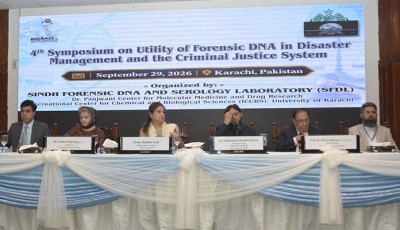
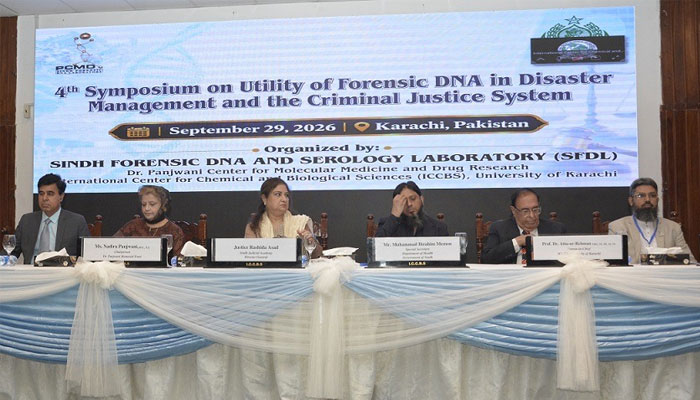
They were speaking at the 4th Symposium on “Utility of Forensic DNA in Disaster Management and the Criminal Justice System,” organized by SFDL at the Prof. Salimuzzaman Siddiqui Auditorium, International Center for Chemical and Biological Sciences (ICCBS), University of Karachi, on Tuesday.
The speakers said forensic DNA provides crucial scientific evidence in cases that may otherwise require considerable time and effort to resolve. They also highlighted the contribution of SFDL, established at the Dr. Panjwani Center for Molecular Medicine and Drug Research (PCMD), University of Karachi.
The symposium was attended by representatives of the Pakistan Armed Forces, Rangers, police, judiciary, Red Cross and various welfare and disaster management organizations.
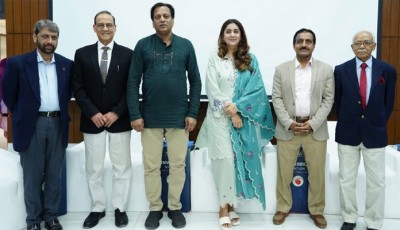
The inaugural session was addressed by Justice Rashida Asad, Director General, Sindh Judicial Academy; Prof. Dr. Atta-ur-Rahman, Professor Emeritus and former Federal Minister for Science and Technology; Prof. Dr. Muhammad Raza Shah, Director ICCBS; Ms. Nadira Panjwani, Chairperson, Dr. Panjwani Memorial Trust; and Dr. Ishtiaq Ahmad Khan, Project Director and In-charge SFDL.
Muhammad Ibrahim Memon, Special Secretary, Department of Health, Government of Sindh, was also present.
Chief Guest Justice Rashida Asad said forensic DNA analysis could help identify or exclude individuals by comparing DNA recovered from a crime scene with samples obtained from suspects or other sources, thereby assisting criminal investigations and court proceedings.
She appreciated the SFDL team for supporting the criminal justice system through high-quality forensic DNA reports in criminal cases.
Prof. Dr. Atta-ur-Rahman praised the laboratory's performance and said further technological advancement was required to enhance its capabilities. He urged government authorities to accord priority to the facility and continue supporting it at the highest level.
Explaining the significance of DNA, he described it as a biological blueprint or identity code of an individual.
Prof. Dr. Muhammad Raza Shah said economic progress was closely linked with advances in science and technology and stressed that the importance of forensic DNA in disaster-related and criminal cases could not be ignored.
He said the conviction rate in Sindh had increased from three percent to 16 percent following the establishment of SFDL. He added that the laboratory had produced high-quality reports in thousands of cases and was meeting the province's requirements by providing comprehensive DNA and serology services. He also thanked the Sindh government for its continued support.
Ms. Nadira Panjwani highlighted the role of the Dr. Panjwani Center in providing research training to highly qualified professionals in emerging areas of molecular medicine and drug development. She also emphasized the importance of forensic DNA evidence, noting that DNA can serve as an identifying trace left behind at a crime scene.
Dr. Ishtiaq Ahmad Khan, while delivering the vote of thanks, said forensic DNA analysis was not only a tool for solving present-day crimes but could also contribute to building a more just, accountable and better-prepared system for the future.
Other sessions were addressed by Dr. Summaiya Syed, Chief Police Surgeon; Amir Hassan, Director, Shanakht Project, CPLC; Dr. Amar Hussain, Legal Adviser, SFDL; and Prof. Dr. Ishtiaq Ahmad Khan.
Dr. Summaiya Syed said medicolegal protocols for mass disasters and identification of deceased victims had been adapted from international standards to suit resource-constrained settings such as Karachi.
She said the Office of the Police Surgeon, Karachi, had developed proformas and standard operating procedures for handling mass disasters, which were successfully utilized during the Gul Plaza incident.
She further noted that DNA analysis was a time-sensitive process dependent on several critical variables and might not always provide the desired answers. She stressed that medicolegal examinations and crime-scene investigations should therefore be comprehensive and address all possible gaps.