
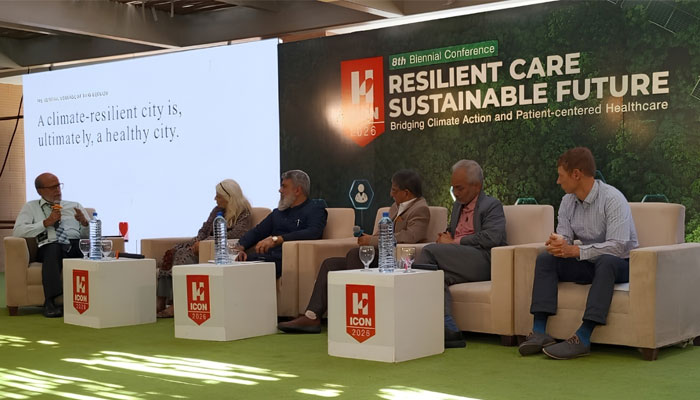
KARACHI: National and international experts at the 8th Biennial Conference (ICON 2026), organized by Indus Hospital & Health Network (IHHN), have called for urgent reforms in urban planning, stronger coordination among government institutions, evidence-based policymaking and the establishment of a joint think tank to address the growing impact of climate change on public health.
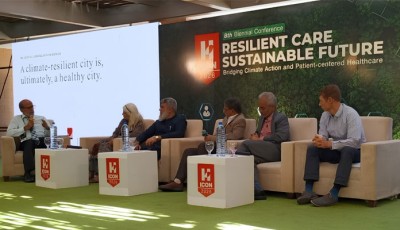
Speaking at a high-level panel discussion titled "Climate Change, Urban Issues and Health Management," the experts emphasized that a climate-resilient city is ultimately a healthy city, warning that unplanned urban expansion, deteriorating infrastructure, environmental degradation and administrative fragmentation are placing millions of people at increasing health risks.
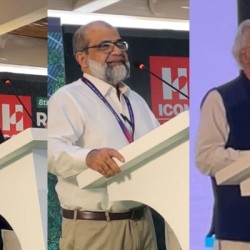
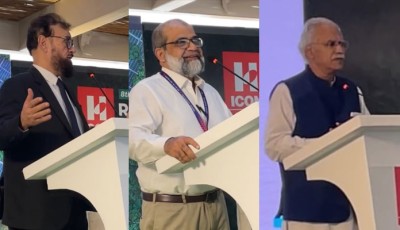
The session was moderated by Dr. Sohail Akhtar, Pulmonologist at IHHN. Panelists included Faisal Ahmed Uqaili, Secretary, Environment, Climate Change and Coastal Development Department, Government of Sindh; Dr. Zafar Zaidi, Dean, Indus University of Health Sciences; Dr. Zafar Fatmi, Professor and Section Head of Environmental, Occupational Health and Injuries at Aga Khan University; Afia Salam, Media Consultant and Environmental Specialist; and Dr. Paul Charlton, Climate Medicine Expert and Co-founder of Healthy Climate, affiliated with the University of Colorado, USA.
Addressing the discussion, Sindh Environment Secretary Faisal Ahmed Uqaili expressed serious concern over Karachi's unplanned urban expansion and fragmented administrative structure. He pointed out that hundreds of housing schemes were being developed without adequate civic infrastructure, while the city's affairs were being managed by 26 different administrative agencies.
He said the lack of coordination among these institutions was a major obstacle to effective urban management and climate adaptation. Without bringing all stakeholders onto a common platform, meaningful improvements could not be expected.
Uqaili proposed the establishment of a jointly developed think tank comprising representatives of government departments, academic institutions, healthcare organizations and civil society to review available data, identify institutional gaps and develop practical, research-based solutions.
Dr. Zafar Zaidi warned that poor urban planning was directly contributing to serious public health challenges, including malaria and other vector-borne diseases, cardiovascular complications and health risks associated with sewage contamination.
He stressed that urban development policies must clearly define institutional responsibilities and accountability mechanisms. He said planning decisions should not focus merely on immediate requirements but should consider their consequences for the next two generations.
Dr. Zafar Fatmi highlighted the disconnect between academic research and government policymaking. He observed that Sindh's health policy had only recently been updated after remaining largely unchanged since 2010.
He said universities and research institutions often focused on academic publications, while the translation of scientific findings into practical policies remained limited. He called for closer collaboration between government departments and academia to jointly identify problems, formulate research questions and develop effective policy interventions.
International climate medicine expert Dr. Paul Charlton emphasized the importance of adopting globally tested, evidence-based solutions to address climate-related health emergencies.
Referring to international initiatives such as the Lancet Countdown toolkit, he said healthcare professionals should be equipped to assess the economic and health consequences of climate change and communicate scientific evidence effectively to policymakers, government officials and the media.
He also stressed the need for specialized training of healthcare professionals in climate-health communication and encouraged Pakistani researchers to present the country's climate-related health data at international forums.
Environmental specialist and media consultant Afia Salam acknowledged emerging improvements in coordination among government departments, particularly during recent pre-monsoon preparedness exercises.
However, she warned that vulnerable populations continued to face serious consequences from extreme weather conditions. She specifically highlighted the risks faced by schoolchildren exposed to intense afternoon heat and Lady Health Workers whose field activities were severely affected by rising temperatures.
She urged policymakers to incorporate the needs of vulnerable communities into climate adaptation strategies and ensure that public health considerations remained central to urban planning.
The panel also discussed the critical role of the media in raising awareness about climate change and public health. Participants observed that journalists frequently faced difficulties obtaining reliable information because government institutions did not always make essential data publicly accessible.
Dr. Zafar Fatmi recommended specialized health and climate communication workshops for journalists to improve scientific reporting and public understanding of environmental health risks.
Dr. Zafar Zaidi emphasized the importance of translating complex scientific findings into local languages so that communities could better understand the risks associated with climate change. He also called for greater youth participation in environmental awareness and advocacy initiatives.
The experts agreed that climate change could no longer be treated solely as an environmental issue, as its consequences were increasingly affecting healthcare systems, urban infrastructure, economic productivity and the well-being of communities.
They stressed that coordinated institutional action, transparent data sharing, responsible urban development, public engagement and sustained collaboration among government, academia, healthcare institutions and the media were essential to building healthier and more climate-resilient cities across Pakistan.