
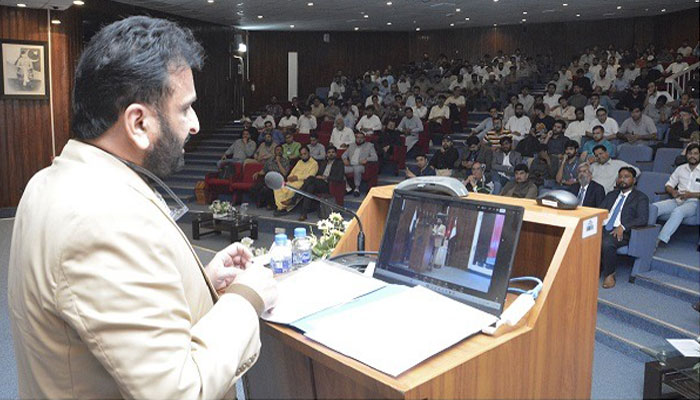
KARACHI: Pakistan Atomic Energy Commission (PAEC) is treating nearly 80 percent of the country's cancer patients through its nationwide network of 21 cancer hospitals and diagnostic centres, while also strengthening research in health, agriculture and energy sectors.
The information was shared by Dr. Shakeel Abbas Rofi, Member (Science), PAEC, while addressing the inaugural session of the international symposium titled "Sustainable Agriculture Under a Climate Change Scenario: From Seeds to Biopesticides, Biostimulants and Biofertilizers" held at the Prof. Salimuzzaman Siddiqui Auditorium of the International Center for Chemical and Biological Sciences (ICCBS), University of Karachi.
Dr. Rofi said the symposium focused on one of Pakistan's most pressing challenges—sustainable agriculture under changing climatic conditions. He appreciated ICCBS for organizing the event and emphasized the importance of strengthening scientific research in health, cancer, agriculture and chemical sciences to support national development.
He said PAEC's agricultural research centres are developing improved crop varieties, promoting climate-resilient farming and strengthening pest management practices to enhance the country's food security. He also highlighted PAEC's contribution to Pakistan's energy sector through its nuclear power programme, which provides clean, reliable and affordable electricity.
Former Federal Minister for Science and Technology Prof. Dr. Atta-ur-Rahman spoke on the growing role of Artificial Intelligence (AI) in chemical sciences. He said AI is transforming Nuclear Magnetic Resonance (NMR) spectroscopy into a faster, more accurate and highly automated tool for chemical research. He also highlighted the progress made in Pakistan's science, technology and higher education sectors during his tenure.
Welcoming participants, ICCBS Director Prof. Dr. Muhammad Raza Shah said organizing international scientific events has long been part of the institution's tradition. He outlined ICCBS's achievements and noted that it is the only Organization of Islamic Cooperation (OIC) Centre of Excellence of its kind with international recognition.
The symposium also featured an online lecture by renowned microbiologist and biotechnologist Prof. Kauser A. Malik on sustainable agriculture. Prof. Dr. Bina Siddiqui presented research on neem and neem-based products, while Dr. Shahid Mansoor stressed the importance of regenerative and organic agriculture in addressing the growing threats of climate change to Pakistan's food, nutritional and fibre security.
Dr. Kashif Riaz Khan of the Nuclear Institute for Agriculture and Biology (NIAB) delivered a presentation on cotton production, while Dr. Farooq A. Khan of ICCBS discussed strategies to protect cotton crops from pests and other harmful organisms. Dr. Nizamuddin Depar of PAEC also addressed the symposium.