
KARACHI: Vice Chancellor of Dow University of Health Sciences Professor Nazli Hossain has said that tuberculosis (TB) continues to pose a serious public health challenge in Pakistan and globally, stressing that achieving the international target of eliminating the disease by 2035 will require coordinated and effective measures.
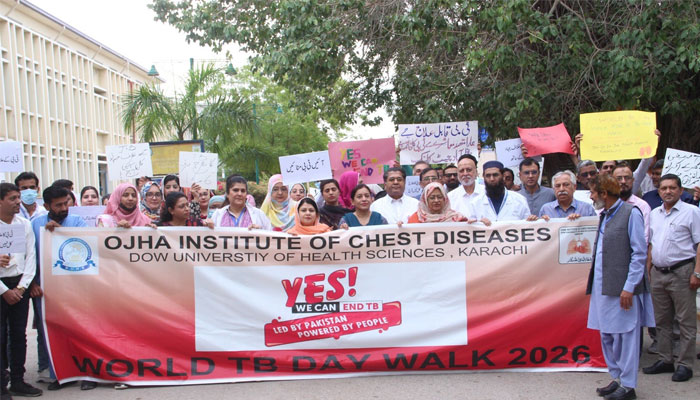
She expressed these views while addressing participants as chief guest at an awareness walk organised by the Ojha Institute of Chest Diseases in connection with World TB Day. She noted that preparations are underway to tackle the challenge and that the institute, with the support of the Sindh government, is playing a key role in TB treatment.
Prof. Hossain said that the Ojha Institute is the largest TB rehabilitation centre in Pakistan and is expected to soon be designated as a collaborative centre for TB by the World Health Organization. Once approved, it will become the first WHO collaborative centre for TB in South Asia.
She further said that the Ojha campus offers facilities including an intensive care unit (ICU) and a Biosafety Level-3 (BSL-3) laboratory for TB patients, which are not widely available elsewhere. She added that diagnostic services, treatment, medicines, and nutritional support are being provided free of cost with the cooperation of the Sindh government.
The walk commenced from the OICD main gate and concluded at Dow University Hospital, with participants carrying banners and placards and chanting slogans such as “Treat TB today, not tomorrow.”
Addressing the gathering, Pro Vice Chancellor Professor Jahan Ara Hassan, OICD Director Dr. Niaz Soomro, and other speakers emphasised the urgency of addressing TB. Among those present were Prof Uzma Bukhari, Principal of Dow International Medical College, Dr. Murtaza Sohoo, Dr. Mohammad Nadeem, Dr. Faisal Fayyaz Zuberi, social worker Yasmeen Sami, and Dr. Saleem Hassan Kazmi, along with faculty members, staff, and a large number of students.
Speakers noted that India ranks first and Pakistan fifth globally in terms of TB burden. In India, approximately 40 per cent of the population is affected by TB infection, while in Pakistan the incidence stands at 266 cases per 100,000 population.
According to the Global TB Report 2025, around 10.7 million people worldwide fell ill with TB last year, of which 8.3 million cases were reported, leaving nearly 22 per cent undiagnosed or unreported. Globally, the incidence rate stands at 134 cases per 100,000 population.
Experts said Pakistan is among the five countries bearing the highest TB burden, with approximately 497,700 cases reported annually, while 25.6 per cent of patients remain outside the healthcare system. Around 51,000 people die each year due to the disease, and 10 to 15 per cent of cases involve children.
They said that across the country, 1,300 basic health units and 1,300 general practitioner clinics are providing TB diagnosis and treatment services, while 63 specialised centres cater to patients with multidrug-resistant TB.
In Sindh, an estimated 154,278 TB cases exist, of which 119,741 have been reported, while 34,537 remain undetected. The province has 455 TB clinics and 16 specialised centres.
Experts warned that an untreated TB patient can infect 10 to 15 individuals annually, underscoring the importance of timely diagnosis and treatment. Common symptoms include a persistent cough lasting more than two weeks, fever, night sweats, weight loss, fatigue, chest pain, and coughing up blood.
Diagnosis is carried out through sputum and blood tests as well as chest X-rays. Standard TB treatment typically lasts six months, while drug-resistant cases may require treatment for six to 18 months.
Speakers reaffirmed their commitment to achieving the global target of eliminating TB by 2035, emphasising that the government, healthcare professionals, and the public must work collectively. They urged people not to ignore a cough lasting more than two weeks and to seek medical attention promptly.
They also recalled that Robert Koch discovered the TB-causing bacterium on March 24, 1882, which is why World TB Day is observed annually on this date. They added that the HIV/AIDS epidemic in the 1980s and 1990s worsened the global TB situation.
In 1993, the WHO declared TB a global emergency, while in 2001 Pakistan also declared TB a national emergency and adopted the DOTS (Directly Observed Treatment, Short-course) strategy to combat the disease.