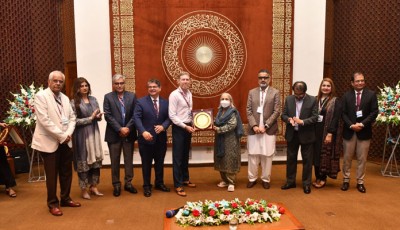

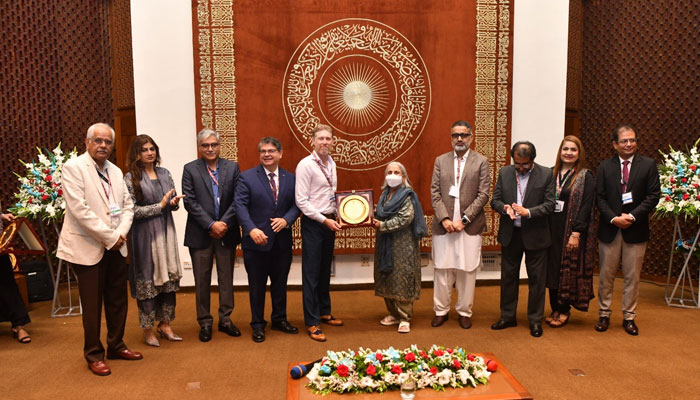
KARACHI: Aga Khan University (AKU), in partnership with the Sindh Department of Health and the People's Primary Healthcare Initiative (PPHI), and with support from the Gates Foundation, convened a province-wide symposium on Monday to mark two years of implementation of the Essential Package of Health Services (EPHS) in Tando Allahyar district.
Held at AKU on September 15, the symposium brought together government officials, development partners, technical experts and frontline health workers to review progress made under the initiative and discuss opportunities for scaling up the model across rural districts of Sindh. Representatives from 13 districts of the province participated in the event.
Tando Allahyar, with a population of nearly one million, around 78 percent of whom live in rural areas, has served as the pilot district for EPHS. The programme comprises 62 health interventions delivered across community, primary healthcare and first-level hospital settings.
Since the programme's launch, Tando Allahyar has become the first district in Sindh to introduce daily digital health reporting through DHIS2 and electronic medical records. A Specialized Care Nursery has also been established at the District Headquarters (DHQ) Hospital, nearly 500 Lady Health Workers have been trained on clinical guidelines, and General Anaesthesia services have been introduced at DHQ Tando Allahyar for the first time.
More than 55 health facility staff have been trained in digital reporting, while an increasing number of the district's 55 health facilities are actively reporting data in real time.
At the DHQ Hospital, the newly established Specialized Care Nursery, staffed by nine specially trained doctors, nurses and technicians, has introduced newborn intensive care capacity that was previously unavailable in the district. Surgical services have also expanded, with nearly 30 percent of procedures now being performed under General Anaesthesia.
Sindh Minister for Health and Population Welfare Dr Azra Fazal Pechuho stressed the importance of ensuring that the initiative does not remain confined to Tando Allahyar.
She said the government wanted a scalable and sustainable model, noting that health interventions often lose momentum once projects end or the people driving them leave a district. Sustainability, she said, must therefore be incorporated into the programme from the outset.
Technical sessions at the symposium covered the development of clinical guidelines for all 62 EPHS interventions, translated into Urdu, English and Sindhi, as well as costing analysis and initiatives aimed at changing provider behaviour.
Speakers said Public Financial Management training and Service Coverage Index surveys undertaken in the district had laid the groundwork for an accountable and evidence-based expansion of the model to other districts of Sindh.
Professor Dr Sameen Siddiqi of AKU's Department of Community Health Sciences said the two-year implementation had generated important lessons in training and capacity enhancement, digitisation of health information systems, community engagement and costing of services.
He said these lessons could guide implementation of EPHS elsewhere in Sindh and across Pakistan, adding that the initiative demonstrated how different stakeholders could work together to address persistent gaps in essential healthcare and advance progress towards Universal Health Coverage.
The symposium also featured remarks by Dr David Wilson of the Gates Foundation and PPHI Sindh CEO Javed Jagirani. Representatives of UNICEF, the World Health Organization, the World Bank, the US State Department and the Sindh Department of Health also attended the event.