
KARACHI: A serious controversy has surfaced at the Dow University of Health Sciences (DUHS) after a Class-IV employee serving as Naib Qasid (BPS-02) was promoted directly to the post of Junior Clerk (BPS-11) — a nine-scale jump that has triggered debate over alleged service-rule violations, political influence, and administrative irregularities.
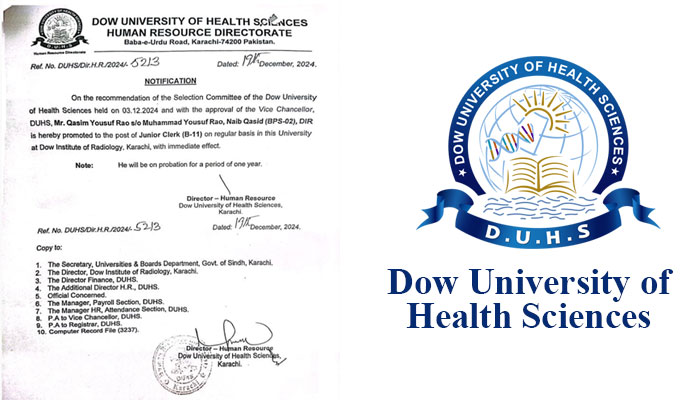
According to an official notification (Ref. No. DUHS/Dir.H.R./2024/5213) issued by the DUHS Human Resource Directorate on December 19, 2024, Mr. Qasim Yousuf Rao was promoted from Naib Qasid to Junior Clerk at the Dow Institute of Radiology with immediate effect. The order, signed by the Director of Human Resource and approved by the Vice Chancellor, places him on a one-year probation period.
Under the Sindh Civil Servants (Appointment, Promotion & Transfer) Rules, 1974, and the Sindh Universities Act, 2018, a Naib Qasid post is categorized as a non-promotable (dead-end) position. Such employees are not entitled to cadre changes unless they qualify and apply through a new recruitment process. HR experts argue that such a jump from Grade-2 to Grade-11 is legally untenable under standard civil service practice.
A senior DUHS official, speaking on condition of anonymity, stated. “A Naib Qasid cannot be promoted to a clerical post under any rule. It’s a non-promotable cadre. This order bypasses the merit-based system and the structured service hierarchy.”
Documents reviewed by Health Matters Media reveal that Mr. Qasim Yousuf Rao is also an office-bearer of the Pakistan Peoples Party (PPP), serving as President of the People’s Paramedical Staff (Dow) — an affiliated PPP wing. He also submitted a PPP nomination form for Labour Councillor (KMC), identifying himself as a Dow employee.
This political affiliation while holding a government job raises ethical concerns and appears to contravene the Sindh Government Servants (Conduct) Rules, 1989, which prohibit employees from engaging in political activity or contesting elections while in service.
Responding to the allegations, the Public Relations Officer (PRO) of DUHS, Mr. Naeem Tahir, quoting the university’s Human Resource Department, stated that the promotion was granted legally, transparently, and in good faith.
Despite the clarification, governance experts insist the Sindh Universities & Boards Department and the Chief Minister’s Inspection Team (CMIT) should independently review whether DUHS’s internal policy permits such cross-cadre promotions. They argue that transparency and merit must be demonstrably maintained in all HR decisions, especially in public universities.
As of filing this report, the DUHS spokesperson maintains that the promotion was made “in line with established precedents and internal rules”, while critics continue to question its legality, fairness, and potential political influence..