

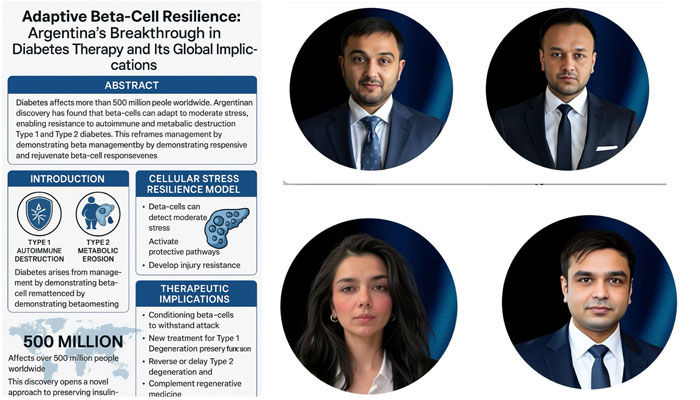
NEWYORK: A new laboratory study from Argentina suggesting that pancreatic beta-cells may strengthen themselves under moderate biological stress has drawn global scientific interest, with experts cautioning that the findings represent early-stage research rather than a new therapy for diabetes. The Mujtaba Clinics Academic Team, which recently reviewed the discovery, described it as an important scientific development but emphasized that it is not a clinical breakthrough or treatment.
The study, conducted at the Immuno-Endocrinology, Diabetes & Metabolism Laboratory of CONICET–Universidad Austral and led by Dr. Marcelo Javier Perone, showed that human beta-cells can activate protective pathways when exposed to controlled, low-level inflammatory stress. Published in Cell Death & Disease, the research indicates that beta-cells may detect mild stress, initiate autophagy and antioxidant signaling, and develop increased resistance to later immune or metabolic injury.
According to the Mujtaba Clinics review, authored by Dr. Athar Mujtaba, Dr. Assad Mujtaba, Dr. Ayesha Mujtaba, and Hyder Mujtaba, these findings shed new light on cellular behavior in diabetes but do not translate into any current medical treatment. The team noted that no drug, clinical protocol, or patient-directed intervention exists based on this mechanism, and the results so far are limited to laboratory models rather than human trials.
The review stated that while the concept could eventually inform future therapeutic strategies — including beta-cell preservation in early Type 1 diabetes, slowing metabolic decline in Type 2 diabetes, and improving survival of transplanted islet or stem-cell–derived cells — such applications remain speculative and years away from clinical evaluation.
Researchers said the discovery is significant because diabetes affects more than 500 million people worldwide, yet current treatments do not prevent the progressive loss of beta-cell function. However, they cautioned that the controlled stress conditions used in the study cannot be compared to the chronic inflammation and metabolic overload experienced by diabetic patients.
The Mujtaba Clinics commentary concluded that the Argentinian work represents a notable scientific insight into beta-cell biology, suggesting that cellular failure in diabetes may not be inevitable. Even so, experts stressed that the findings should not be interpreted as a cure or therapy, underscoring the need for further validation, animal studies, and eventual human trials before any clinical relevance can be
established.