
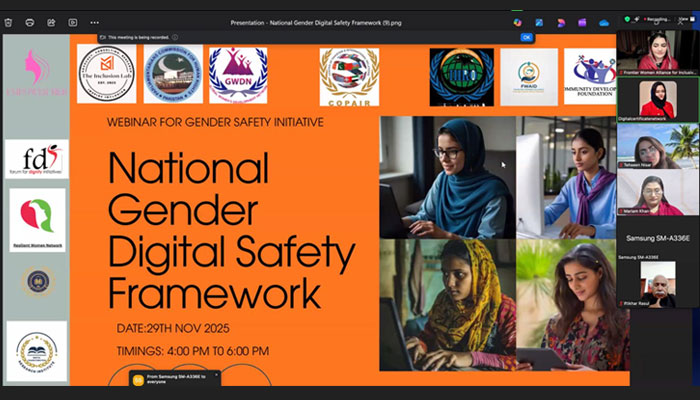
ISLAMABAD: A landmark national webinar on the National Gender Digital Safety Framework was held this week, jointly hosted by EmpowerHer and the Frontier Women Alliance for Inclusive Development (FWAID). The event brought together district-level representatives, national stakeholders, global experts, policy advisors, and international development partners to confront the escalating threat of tech-facilitated gender-based violence (TFGBV), with a special focus on women with disabilities and transgender communities who remain disproportionately vulnerable to online harms.
Experts and speakers underscored that Pakistan’s digital landscape is rapidly expanding, with more than eight million women now active online according to 2024 digital inclusion statistics. However, this growing digital presence continues to collide with cultural stigma, patriarchal norms, and systemic safety gaps, creating an environment where gender-based violence has evolved into more complex forms including cyberstalking, deepfake exploitation, image-based abuse, coercive control, and online blackmail.
Participants stressed that this trend demands specialized regulatory responses and survivor-centered accountability systems across federal, provincial, and territorial jurisdictions.
During the discussion, speakers emphasized that digital violence is not merely a technological challenge but a reflection of deep-rooted structural inequalities. They called for a rights-based, survivor-centered digital safety framework supported by specialized regulations, standardized SOPs, improved institutional capacity, and stronger enforcement mechanisms nationwide. The forum highlighted that meaningful progress on TFGBV can only be achieved if digital safety agendas are informed by the lived realities of women, particularly those in rural and underserved communities.
Addressing the webinar, Ms. Rabia Tahir, Founder and President of FWAID, stressed the urgency of bridging the gap between policy decisions made in federal and provincial capitals and the ground realities faced at the district level. She stated that a digital safety framework must be inclusive of diverse identities and intersectional vulnerabilities to truly protect every woman and girl. She reiterated FWAID’s vision of “inclusion for all” and emphasized the importance of ensuring the rights, livelihood opportunities, and dignified participation of women with disabilities in Pakistan’s digital future.
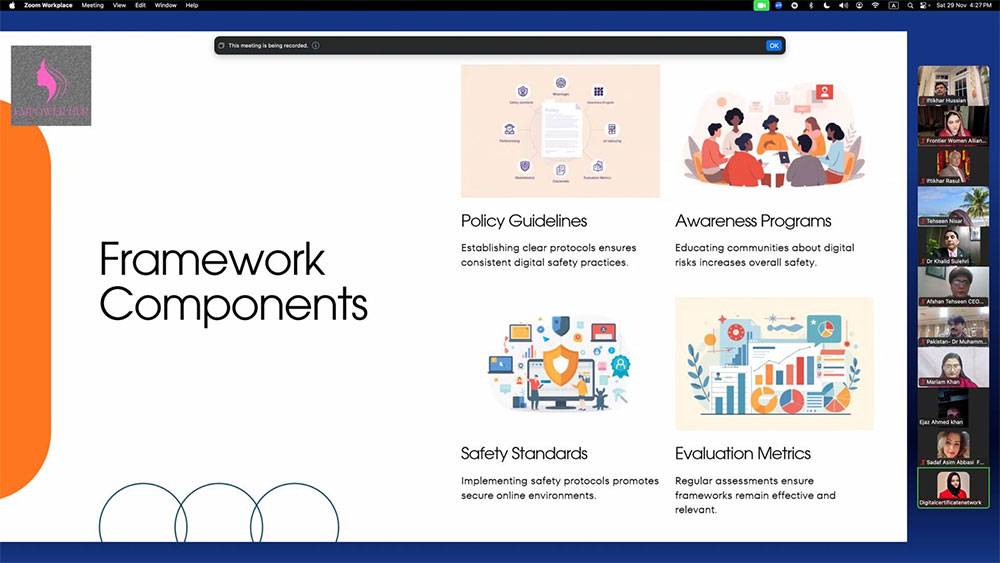
Ms. Amna Munawwar Awan, President of CoPAIR and EmpowerHer, presented the National Gender Digital Safety Framework and informed stakeholders that its technical implementation will be carried out across Pakistan, followed by a policy presentation to the Ministry of Human Rights.
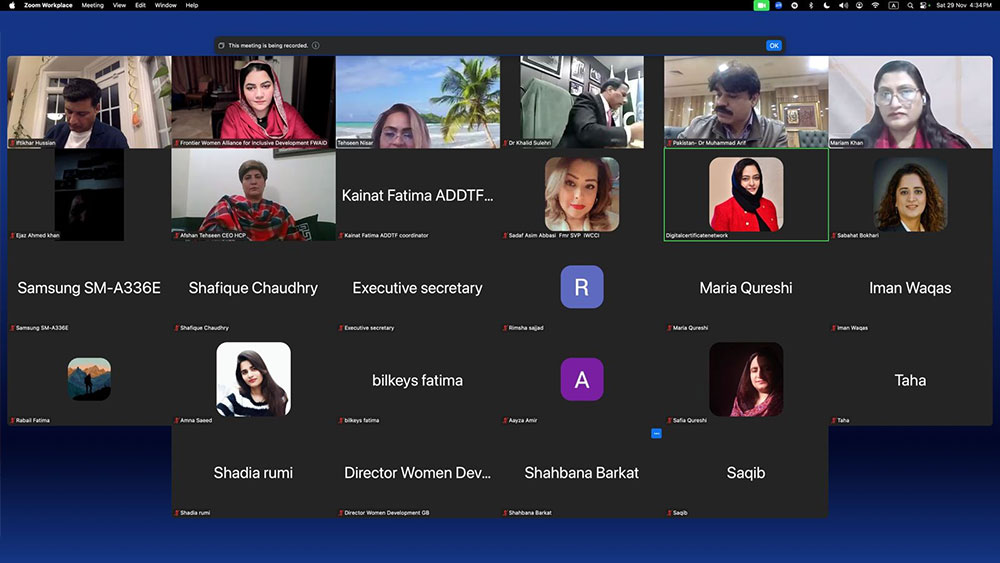
The webinar featured contributions from prominent experts and advocates including Ms. Sabahat Bokhari (Inclusion Lab), Dr. Afshan Tehseen (CEO Human Capital Pakistan and Former Chairperson NCRC), Dr. Arif Laghari (Director IC, Ministry of Human Rights), Dr. Khalid Sulehri (Founder International Human Rights Observer), Ms. Maria Qureshi (National Forum of Women with Disabilities), Ms. Tahseen (Author & Activist, Italy), Mr. Iftikhar Hussain (Communications Specialist, VOA Pashto Washington), Ms. Mehreen Elahi (Founder, The Majmua Art Gallery), Ms. Syeda Kainat Fatima (Aging, Disability & Diversity Task Force), Ms. Mariam Khan (Global Women Development Network), Ms. Quratul Ain (Vice President FPCCI), Ms. Yasmin Karim (Activist & Expert, Gilgit-Baltistan), and Ms. Sadaf Asim Abbasi (Former Vice President IWCCI). Youth from NUST Business School also participated, contributing insights on youth engagement and digital literacy.
The forum also acknowledged messages of support from Ms. Fauzia Waqar, Chairperson FOSPAH, and Ms. Zubeda Jalal, former Federal Minister for Defence Production, reaffirming their commitment to gender equality, digital safety, and inclusive policy development.
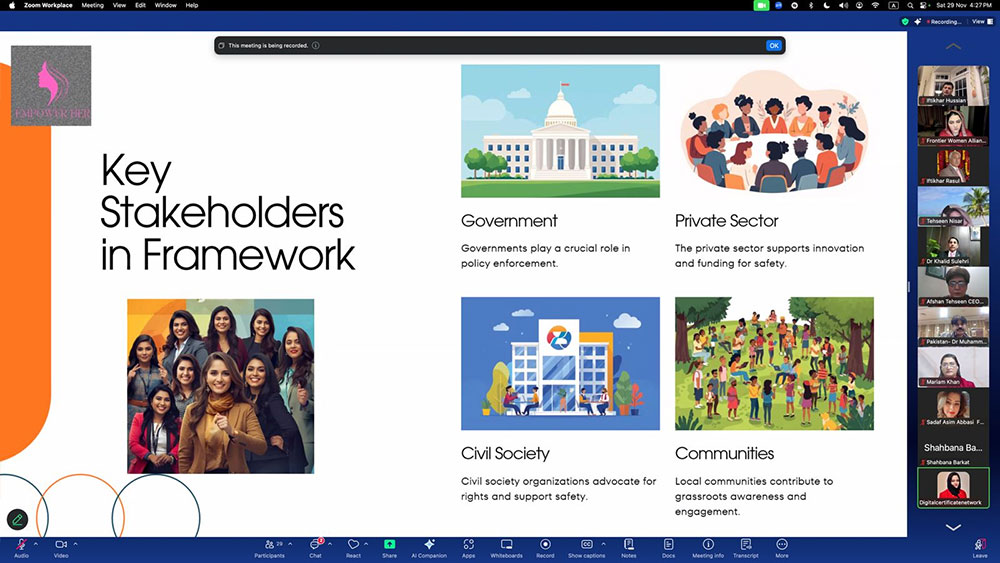
Participants concluded that the virtual world is as real as the physical world, and when online harms remain unaddressed, marginalized groups — especially women with disabilities and transgender persons — face the most severe consequences. The webinar ended with unified recommendations calling for stronger policy frameworks, inclusive reporting systems, government–civil society collaboration, targeted protections for rural women and vulnerable communities, research-based interventions, and equitable participation in Pakistan’s digital transformation.
The national forum was seen as a significant step toward building a future where Pakistan’s digital spaces are safe, inclusive, and grounded in dignity and equality for all.