
KARACHI: Pakistan is home to an extraordinary diversity of medicinal plants, with over 400 species identified for their therapeutic potential, said renowned scientist Prof. Dr. Atta-ur-Rahman.
Speaking at a special lecture titled “Some Exciting Developments in Natural Product Chemistry and Higher Education”, organized by the UNESCO Chair on Medicinal and Bio-Organic Natural Product Chemistry at the International Center for Chemical and Biological Sciences (ICCBS), University of Karachi, Dr. Atta-ur-Rahman highlighted the country’s botanical wealth.
“Pakistan, with its eight diverse climatic zones, harbors approximately 6,000 plant species,” he said. “The H. E. J. Research Institute of Chemistry has collected around 6,000 extracts from 2,200 plant species found across the country, making it the largest collection of its kind in the region.”
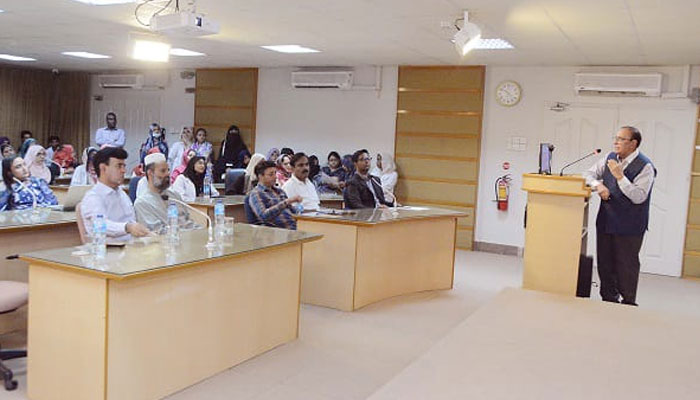
The event, held on Thursday, drew a large audience of students, researchers, and faculty members. Prof. Dr. Muhammad Raza Shah, Director of ICCBS and UNESCO Chair Holder, delivered the welcome address and shared the institution's achievements in natural product chemistry.
Dr. Atta-ur-Rahman, a globally acclaimed chemist and former Federal Minister for Science and Technology, spoke about the groundbreaking research under his leadership on bioactive compounds extracted from indigenous medicinal plants. He noted that many of these compounds hold great promise in treating neurological and oncological disorders.
“Epilepsy, which affects 50 to 60 million people globally, is linked to genetic defects, head trauma, ischemia, and tumors,” he said. “Our team is developing promising anti-epileptic compounds from natural sources that could offer significant medical benefits.”
He also shed light on cutting-edge research in neuroscience, including the molecular mechanisms of memory storage and the synthetic development of anti-cancer drugs such as Velbe and Oncovin.
The lecture also traced the transformation of Pakistan’s higher education landscape during his tenure as the Founding Chairman of the Higher Education Commission (HEC). His policy reforms, he said, laid the foundation for research excellence and institutional development in science and technology.
The session concluded with an engaging Q&A, where participants discussed various aspects of natural product research and future directions for Pakistan’s scientific advancement.