
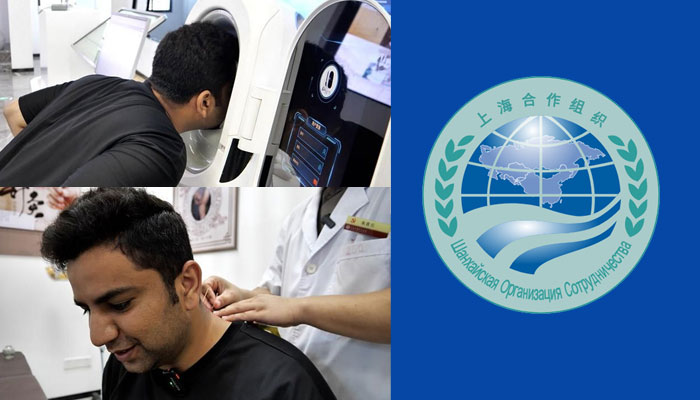
NANCHANG (Xinhua): At the Shanghai Cooperation Organization (SCO) Traditional Medicine Forum, visitors to the Traditional Chinese Medicine (TCM) pavilion were greeted with an unusual instruction: “Face the device and stick out your tongue.” Among them was Abdullah Haseeb, a Pakistani postgraduate medical student, who leaned toward a capsule-shaped machine as flashing lights signaled that an artificial-intelligence (AI) system was analyzing the data from his face and tongue. It was his very first hands-on encounter with the fusion of TCM and AI.
“This feels just like a science-fiction movie!” Haseeb exclaimed. A postgraduate student at Nanchang University in Jiangxi Province, he had traveled specifically to attend the high-level forum held from September 24 to 26. More than 100 institutions from around the world participated, but what impressed him most was the way ancient healing methods were being merged with cutting-edge AI.
Haseeb next offered his left wrist to a pulse-reading device. A silver sensor gently touched his skin and instantly projected his pulse data onto a screen. Pointing to the moving graphics, he remarked, “Look, these are my pulse waves. It’s like giving TCM a translator that converts an invisible pulse into visual data.”
According to staff, the system can identify more than 100 body types. By learning from centuries-old medical records and modern clinical cases, the AI develops intelligent diagnostic models and treatment plans. Once a prescription is generated, an automated pharmacy dispenses the required herbs within just 20 seconds, boasting an accuracy rate of 99.97 percent.
The herbal-tea zone showcased even more advanced technology. Sixty smart decoction pots, controlled by AI, precisely adjust heating levels, while six machines simultaneously vacuum-pack the finished tea. Observing the process, Haseeb noted that preparing such decoctions once required hours of supervision, but automation now keeps ingredient variations within five percent—something human hands can hardly achieve.
Using a traceability platform, Haseeb tapped a sample of astragalus root to reveal details such as soil pH, rainfall records, and harvest dates, eliminating concerns about quality. “Good medicine depends on good herbs,” he said, appreciating the transparency that is key to TCM’s global reach.
Xu Qing, deputy director of the Ganjiang Chinese Medicine Innovation Center, explained that his team is building nine major databases and using AI to “decode” the active components of medicinal herbs—“like understanding a black box,” he said.
According to China’s National Health Commission, TCM is now practiced in 196 countries and regions, and the SCO Traditional Medicine Forum serves as a vital platform for its international promotion. Liu Qian, vice president of Jiangxi University of TCM, noted that the province has already trained more than 3,000 international students in TCM degree programs.
Holding a freshly packed herbal tea produced by an intelligent machine, Haseeb concluded, “China is truly a leader in TCM education. Today I saw with my own eyes how modern technology gives traditional Chinese medicine a language the world can understand. Pakistan also has rich herbal resources, and there is enormous potential for collaboration. As a medical student, I hope to become a bridge for medical exchange between Pakistan and China.”
These innovations, born along the banks of the Ganjiang River, are now reaching the world through the SCO platform.