
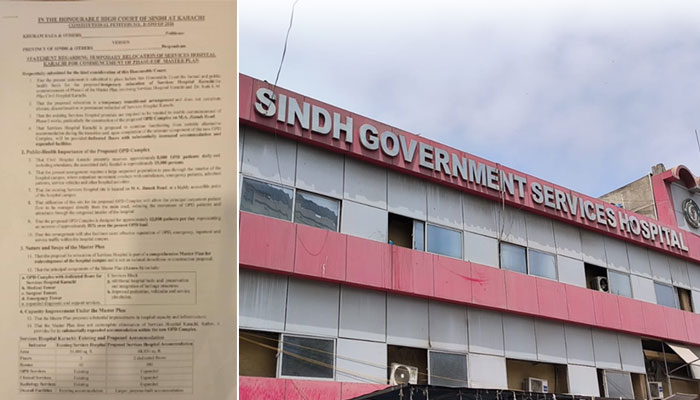
KARACHI: Public-interest petitioners challenging the proposed relocation of Services Hospital Karachi have rejected the statement submitted before the Sindh High Court by the hospital administration and demanded a formal undertaking from the Secretary Health Sindh guaranteeing a 100-room facility for Services Hospital within the proposed redevelopment of Dr. Ruth K.M. Pfau Civil Hospital Karachi.
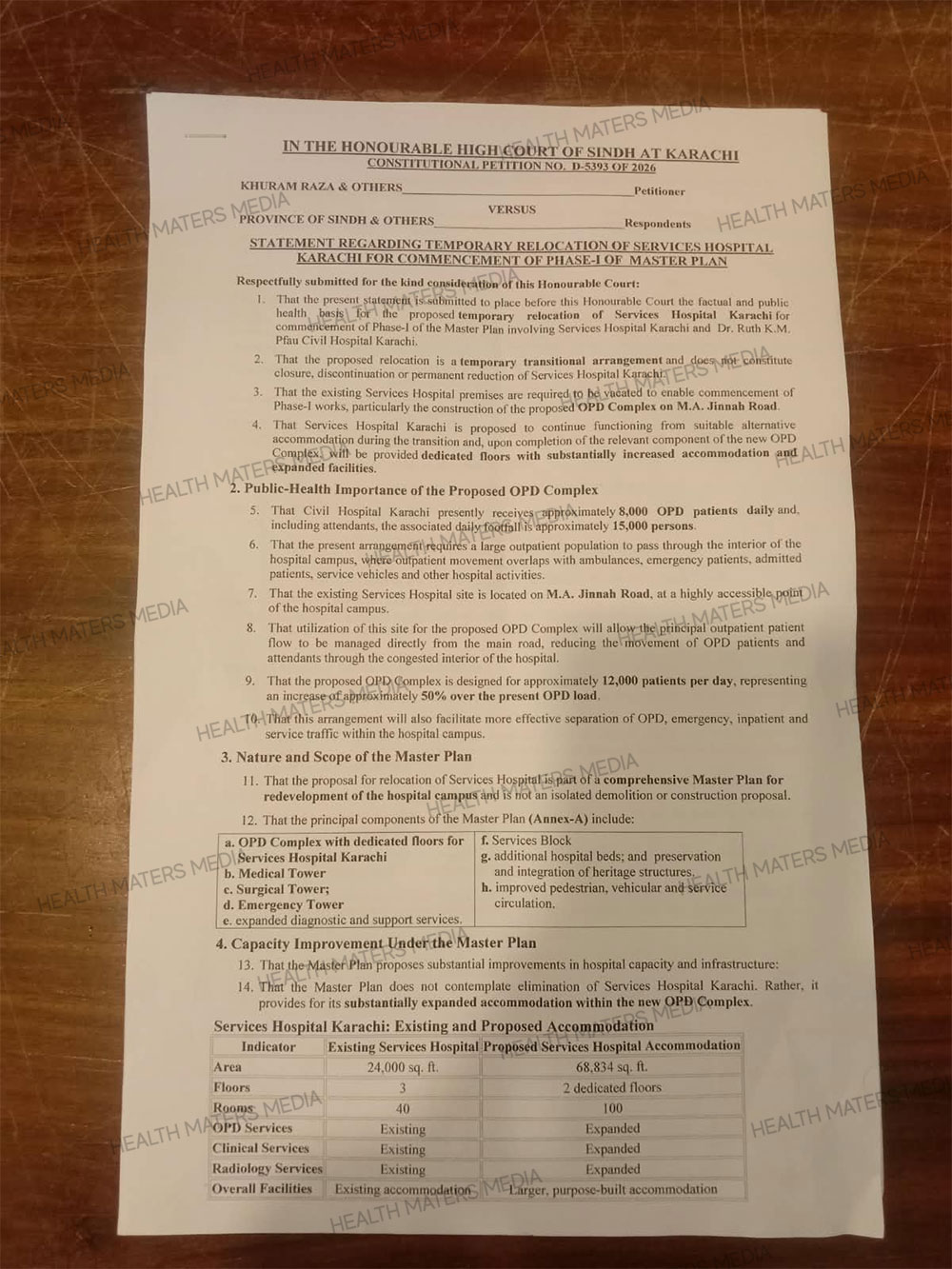
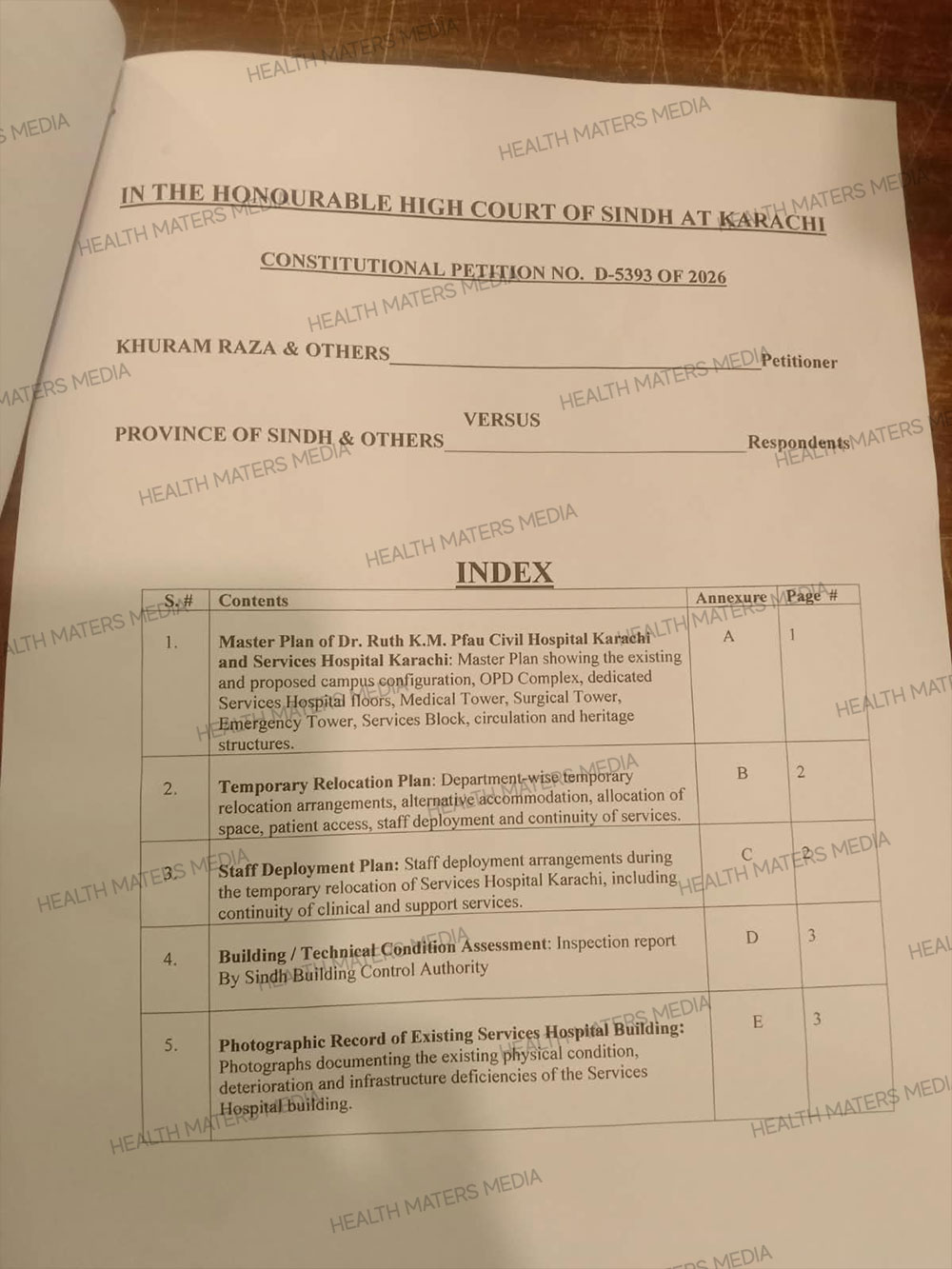
The development came in proceedings concerning Constitutional Petition No. D-5393 of 2026, Khuram Raza & Others versus Province of Sindh & Others, along with connected public-interest petitions CP D-6073 and D-6074 of 2026 concerning the proposed relocation and future of Services Hospital Karachi.
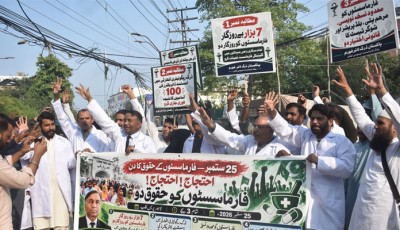
Speaking to the media on behalf of the public-interest petitioners, Advocate High Court Ahsan Bari, former President of Voice Against Corruption NGO, said the statement submitted by the Medical Superintendent was categorically rejected by the petitioners and would not be considered sufficient unless the Secretary Health Sindh formally placed his position and undertaking before the court.
Bari said the petitioners wanted an unequivocal commitment from the Health Secretary confirming that Services Hospital Karachi would be allocated a 100-room facility within the new hospital infrastructure, along with submission of the comprehensive project plan for the approximately Rs100 billion redevelopment.
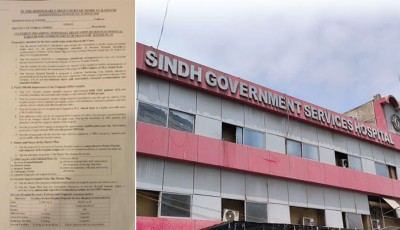
The statement placed before the court describes the proposed relocation of Services Hospital as a “temporary transitional arrangement” rather than closure, discontinuation or permanent reduction of the hospital.
According to the document, the existing Services Hospital premises are required to be vacated to facilitate Phase-I of the Civil Hospital Karachi Master Plan, particularly construction of a proposed OPD Complex on M.A. Jinnah Road.
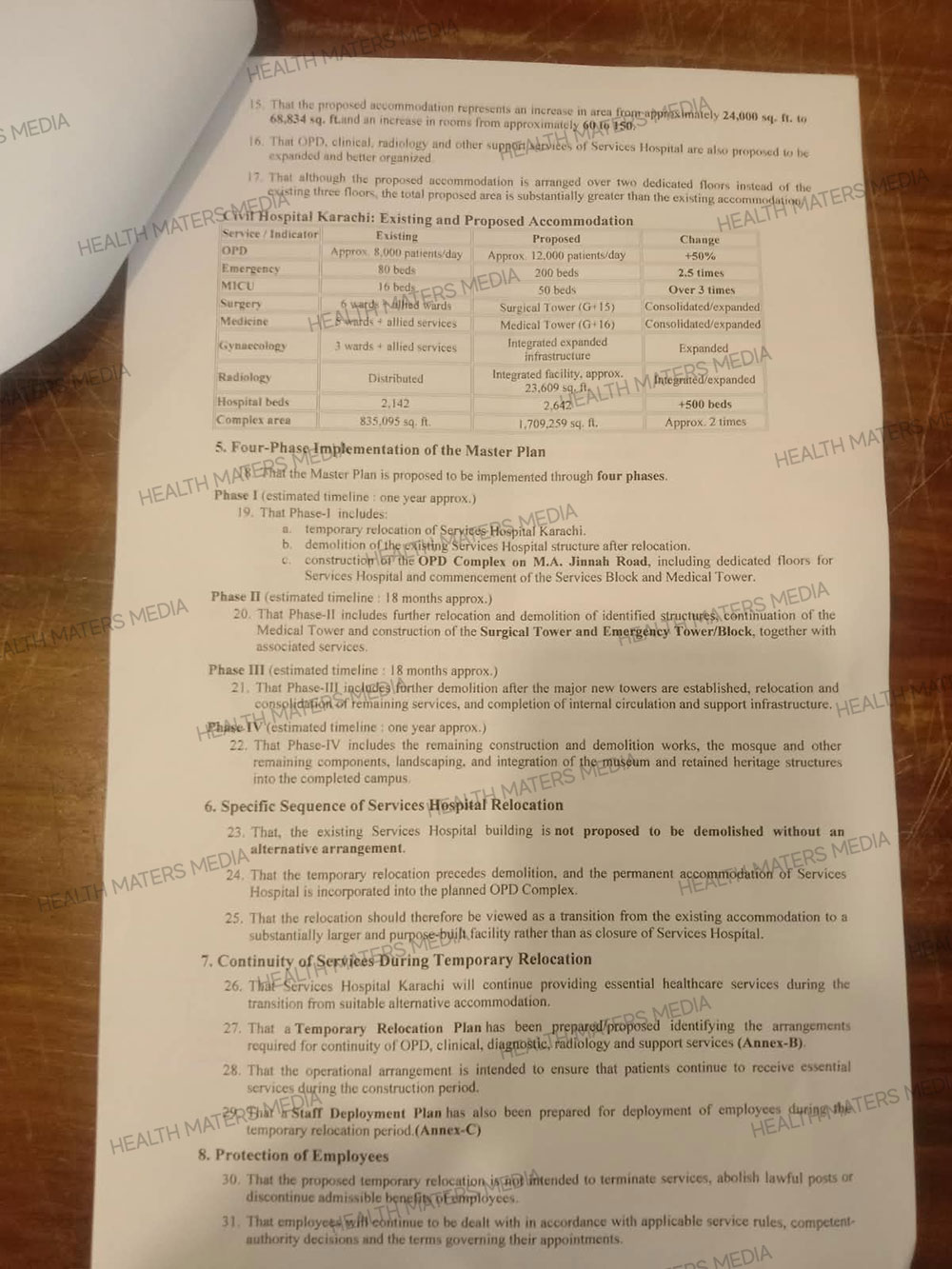
The document states that Services Hospital currently occupies approximately 24,000 square feet with 40 rooms across three floors. Under the proposed plan, the hospital would eventually receive approximately 68,834 square feet with 100 rooms on two dedicated floors, together with expanded OPD, clinical and radiology facilities.
It further states that Civil Hospital Karachi currently receives approximately 8,000 OPD patients daily, while the associated daily footfall is around 15,000 people. The proposed OPD Complex is designed to accommodate approximately 12,000 patients per day, representing a projected 50 percent increase in OPD capacity.
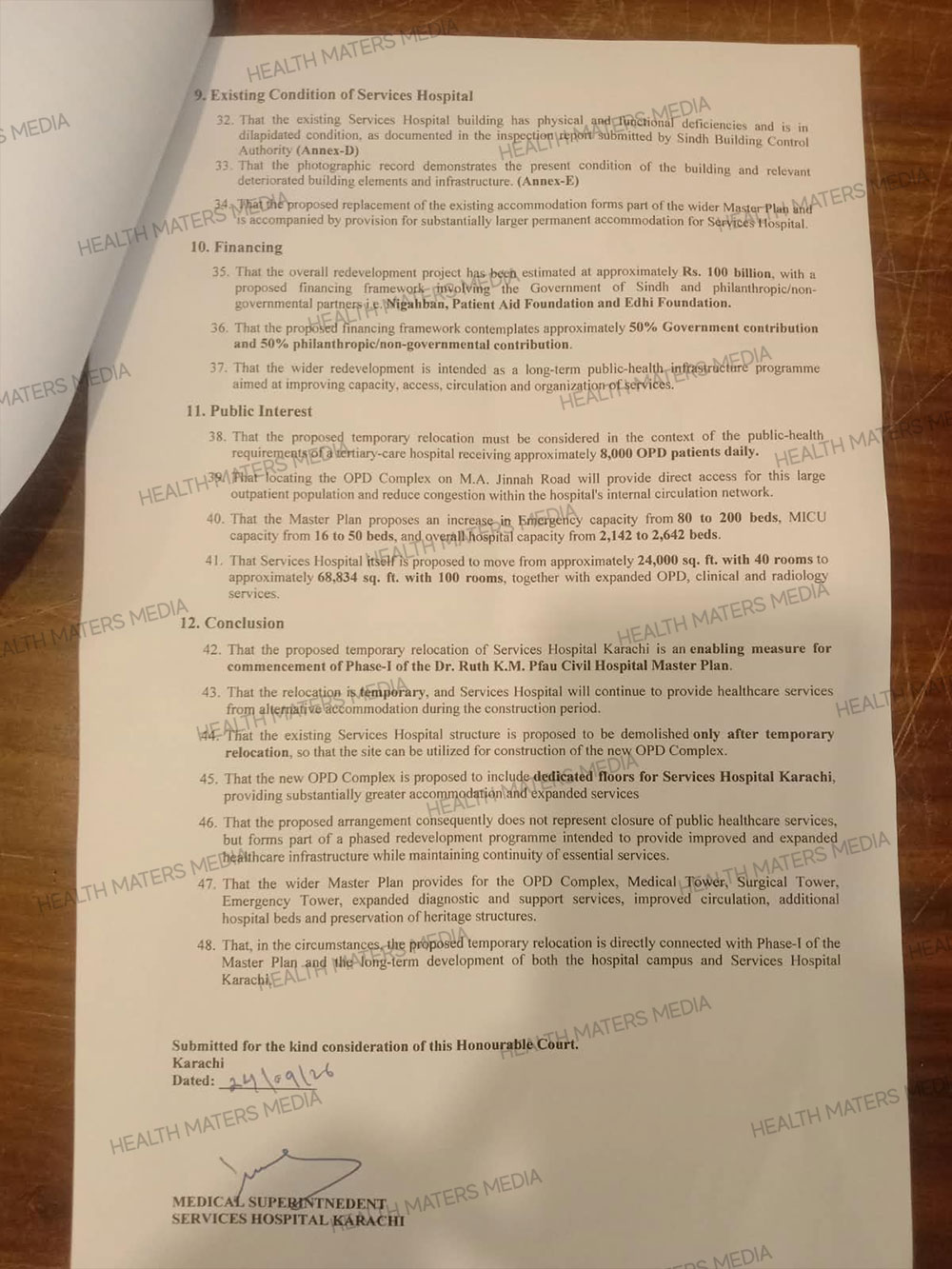
Under the wider master plan, emergency capacity is proposed to increase from 80 to 200 beds, MICU capacity from 16 to 50 beds and overall hospital capacity from 2,142 to 2,642 beds.
The proposed redevelopment includes an OPD Complex with dedicated floors for Services Hospital Karachi, a Medical Tower, Surgical Tower, Emergency Tower/Block, Services Block, expanded diagnostic and support services, additional hospital beds, improved circulation and preservation and integration of heritage structures.
According to the statement, the redevelopment is proposed to be implemented in four phases. Phase-I, with an estimated duration of approximately one year, includes temporary relocation of Services Hospital, demolition of its existing structure after relocation, construction of the OPD Complex on M.A. Jinnah Road and commencement of the Services Block and Medical Tower.
Phase-II, estimated at approximately 18 months, includes further relocation and demolition of identified structures, continuation of the Medical Tower and construction of the Surgical Tower and Emergency Tower/Block. Phase-III, also estimated at approximately 18 months, envisages further demolition after major new towers are established, relocation and consolidation of remaining services and completion of internal circulation and support infrastructure.
Phase-IV, estimated at approximately one year, covers the remaining construction and demolition works, landscaping and integration of the museum and retained heritage structures into the completed campus.
The statement specifically maintains that the existing Services Hospital building would not be demolished without an alternative arrangement. It says temporary relocation would precede demolition and essential healthcare services would continue from suitable alternative accommodation during construction.
It also states that a Temporary Relocation Plan and Staff Deployment Plan have been prepared and that the proposed relocation is not intended to terminate services, abolish lawful posts or discontinue admissible benefits of employees.
The document estimates the overall redevelopment project at approximately Rs100 billion and proposes a financing framework involving the Sindh government and philanthropic/non-governmental partners, including Nighaban, Patient Aid Foundation and Edhi Foundation. According to the statement, approximately 50 percent of the financing is contemplated from the government and 50 percent from philanthropic/non-governmental sources.
Advocate Ahsan Bari, however, strongly objected to this proposed arrangement and alleged that Dr. Syed Muhammad Khalid Bukhari was effectively acting as both “contractor and manager” of the redevelopment by handling key affairs and submitting statements, while, according to Bari, the Secretary Health Sindh and Chief Secretary Sindh had yet to place their own clear positions on record.
Bari maintained that a Rs100 billion healthcare infrastructure project should be financed and managed entirely by the Sindh government, arguing that the amount should not be treated as an unaffordable burden for the provincial government when the project concerns major public healthcare institutions serving millions of citizens.
He questioned the proposed involvement of philanthropic and non-governmental organisations in financing or operating facilities within a major government hospital and maintained that responsibility for providing essential healthcare should remain with the provincial government.
Bari also alleged that organisations including the Patient Aid Welfare Society charge patients for certain services and argued that charging patients at public healthcare facilities raises questions concerning citizens’ fundamental rights. He demanded that all modernised medical facilities developed under the proposed master plan should be provided entirely free of cost to patients.
“The people of Sindh are entitled to modern public healthcare facilities without financial barriers. If Rs100 billion is required for this project, the Sindh government should bear the responsibility and ensure that the facilities remain under public control and free for patients,” Bari said.
He reiterated that the petitioners would accept nothing short of formal comments and an undertaking from the Secretary Health Sindh confirming allocation of the proposed 100-room facility for Services Hospital Karachi, along with the complete project plan, financing arrangements, management structure and guarantees regarding continuity of healthcare services.
The petitioners have also sought continued judicial oversight of the project. Bari said that from commencement of construction until completion, the Additional Member Inspection Team (MIT) of the Sindh High Court should conduct monthly visits to the project and submit progress reports to the court.
The hospital administration, meanwhile, has maintained in its statement that the proposed arrangement does not amount to closure of Services Hospital Karachi but is part of a phased redevelopment programme intended to expand healthcare infrastructure while maintaining continuity of essential services.
The matter is now set for further hearing before the Sindh High Court next Tuesday, when the future of Services Hospital Karachi, the assurances sought from the provincial health authorities and the proposed redevelopment arrangements are expected to remain under consideration.