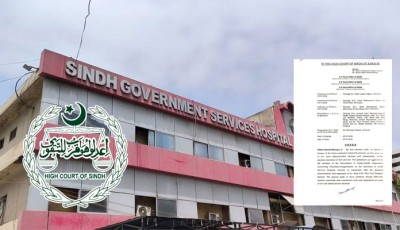

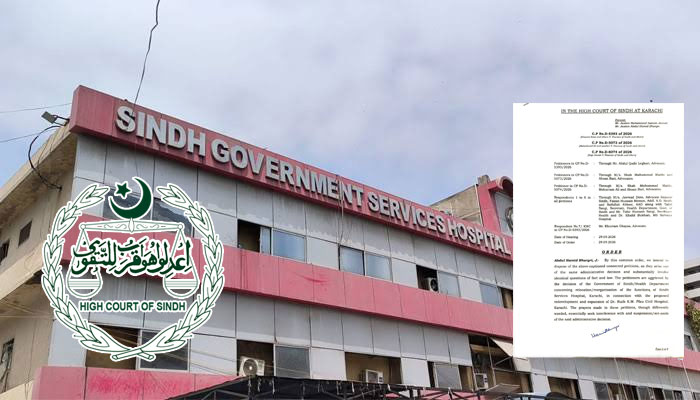
KARACHI: The Sindh High Court has dismissed three constitutional petitions challenging the Sindh government’s decision regarding the relocation and reorganisation of Sindh Services Hospital, Karachi, in connection with the proposed redevelopment and expansion of Dr Ruth K.M. Pfau Civil Hospital, while directing the authorities to ensure uninterrupted access to essential healthcare services during the relocation process.
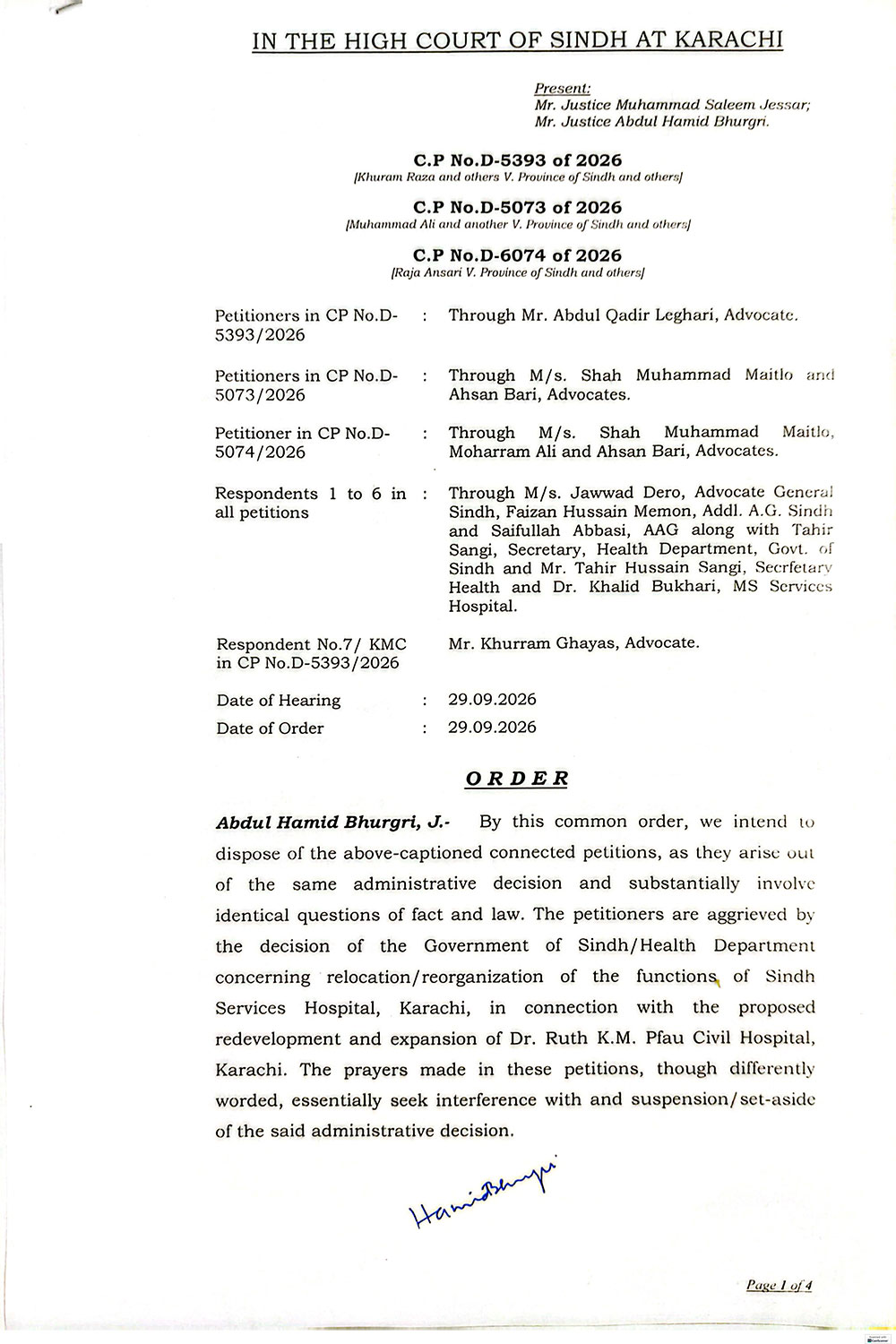
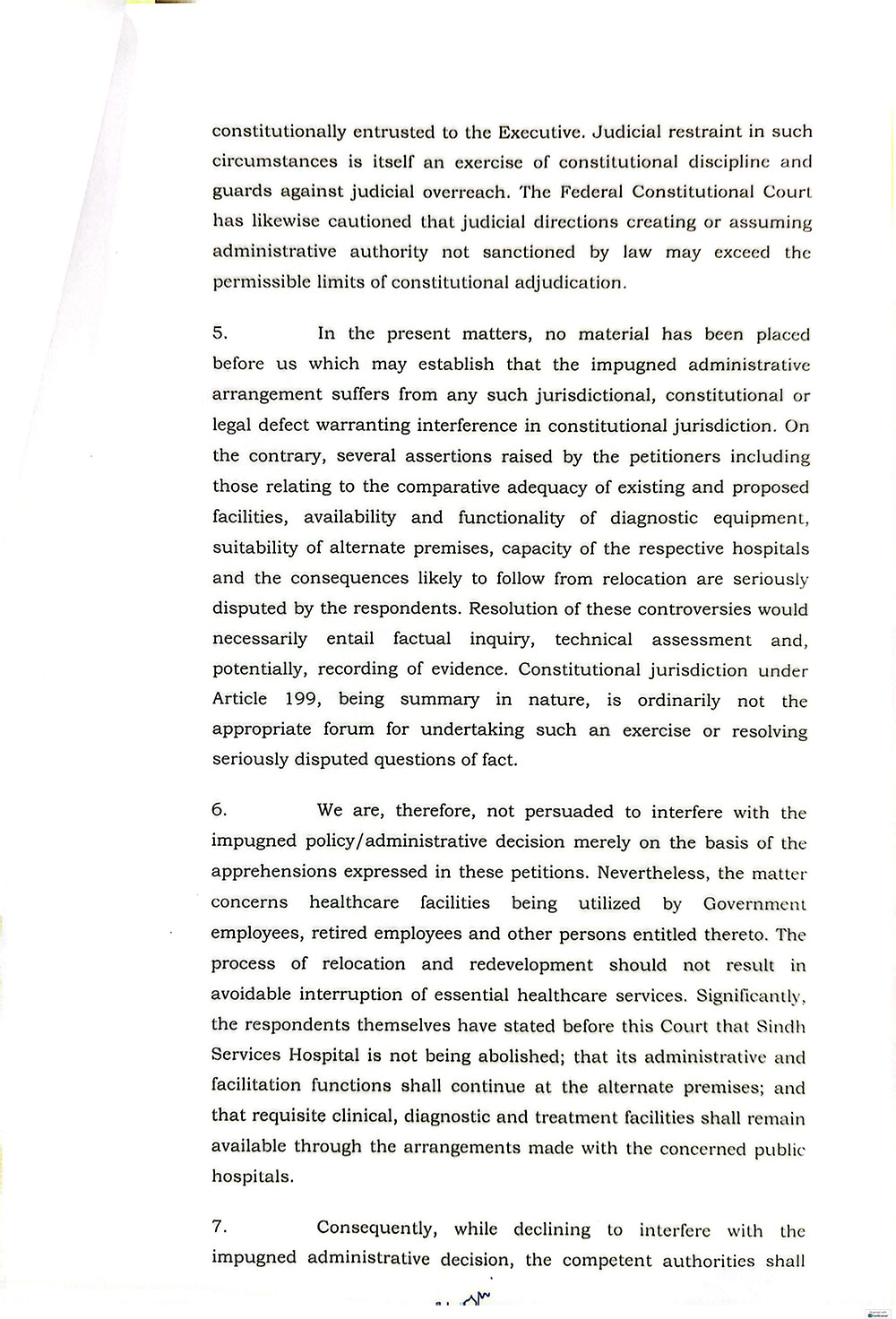
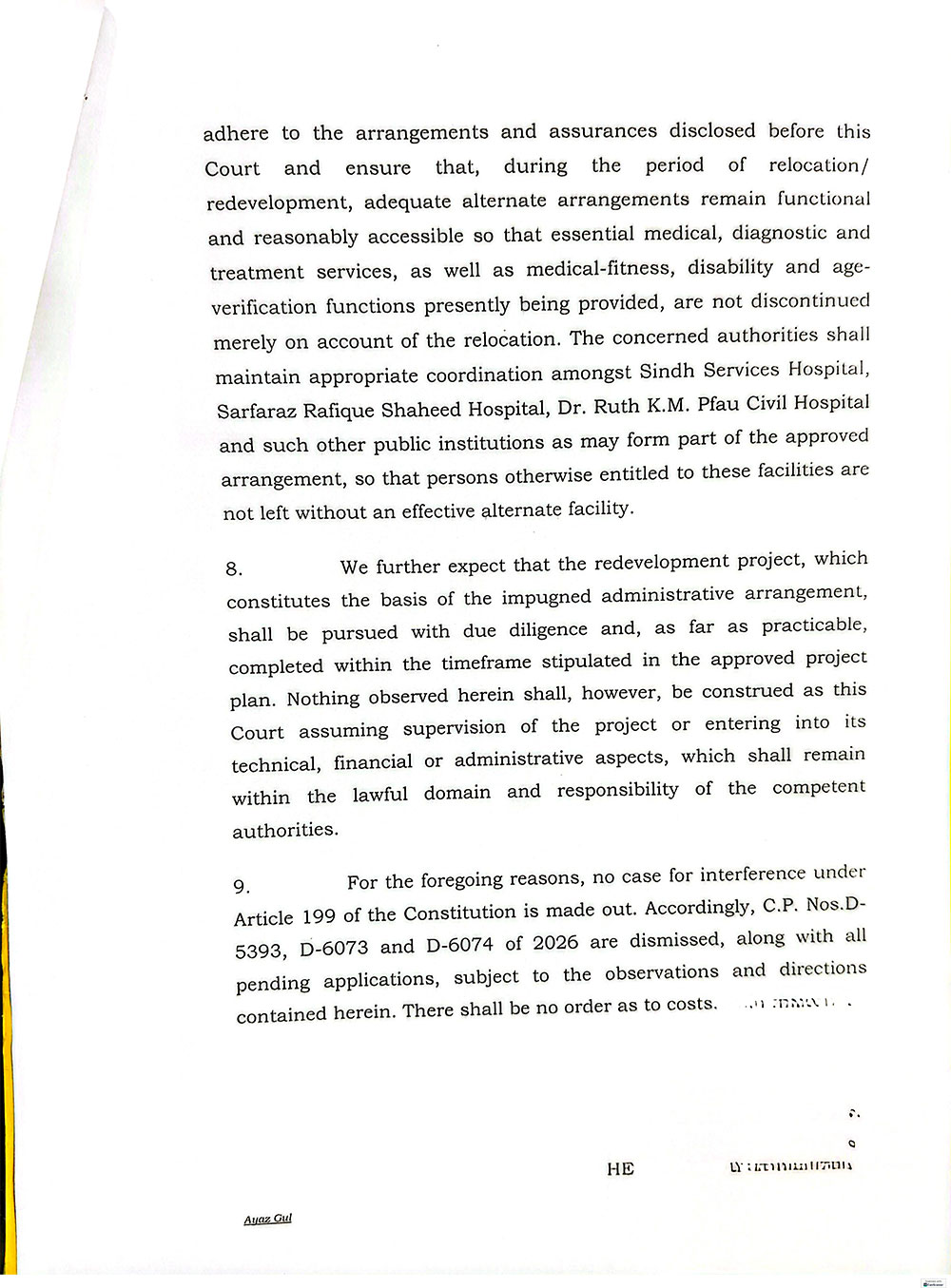
A division bench comprising Justice Muhammad Saleem Jessar and Justice Abdul Hamid Bhurgri passed the common order on September 29, 2026, in C.P. Nos. D-5393, D-6073 and D-6074 of 2026.
Advocates Shah Muhammad Maitlo and Ahsan Bari represented the petitioners in the legal challenge concerning the relocation and reorganisation of Sindh Services Hospital and the proposed redevelopment plan.
The petitions had sought the court’s intervention to suspend or set aside the administrative decision concerning the relocation and reorganisation of Sindh Services Hospital.
The Sindh Health Department informed the court that the arrangement was part of a broader redevelopment plan aimed at enhancing the capacity and infrastructure of Dr Ruth K.M. Pfau Civil Hospital. The proposed development includes an OPD complex and allied facilities.
The government maintained that Sindh Services Hospital was neither being abolished nor were its essential functions being discontinued, and that alternative arrangements had been made for continuation of the services currently being provided by the hospital.
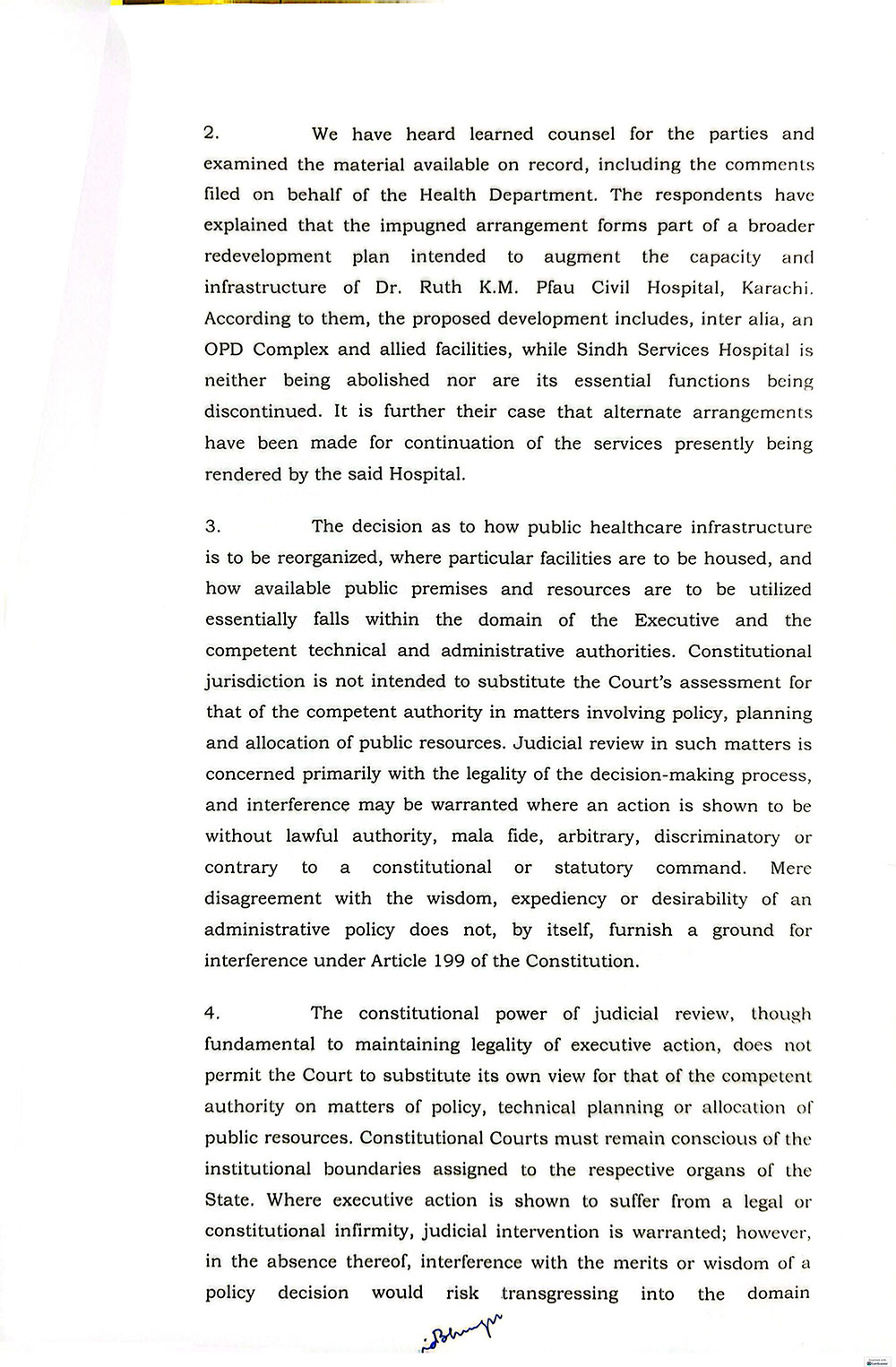
The court observed that decisions regarding the reorganisation of public healthcare infrastructure, location of particular facilities and utilisation of available public premises and resources essentially fall within the domain of the executive and competent technical and administrative authorities.
The bench held that constitutional jurisdiction was not intended to substitute the court’s assessment for that of the competent authority in matters involving policy, planning and allocation of public resources.
It observed that judicial review in such matters primarily concerns the legality of the decision-making process and interference may be warranted where an action is shown to be without lawful authority, mala fide, arbitrary, discriminatory or contrary to a constitutional or statutory command.
The court noted that the petitioners had raised concerns regarding the comparative adequacy of existing and proposed facilities, availability and functionality of diagnostic equipment, suitability of alternative premises, capacity of the respective hospitals and possible consequences of relocation.
However, these assertions were disputed by the respondents and, according to the court, their resolution would require factual inquiry, technical assessment and potentially recording of evidence.
The bench observed that constitutional jurisdiction under Article 199, being summary in nature, was ordinarily not the appropriate forum for resolving seriously disputed questions of fact.
The court found that no material had been placed before it establishing any jurisdictional, constitutional or legal defect in the challenged administrative arrangement that would warrant interference.
It therefore declined to interfere with the policy and administrative decision merely on the basis of apprehensions expressed in the petitions.
However, the bench emphasised that the matter concerned healthcare facilities being utilised by government employees, retired employees and other entitled persons and that the relocation and redevelopment process should not result in avoidable interruption of essential healthcare services.
The respondents stated before the court that Sindh Services Hospital was not being abolished, its administrative and facilitation functions would continue at alternative premises and requisite clinical, diagnostic and treatment facilities would remain available through arrangements with concerned public hospitals.
The court directed the competent authorities to adhere to the arrangements and assurances placed before it and ensure that adequate alternative arrangements remain functional and reasonably accessible throughout the relocation and redevelopment period.
It further directed that essential medical, diagnostic and treatment services, as well as medical-fitness, disability and age-verification functions presently being provided, should not be discontinued merely because of the relocation.
The authorities were directed to maintain appropriate coordination among Sindh Services Hospital, Sarfaraz Rafiqui Shaheed Hospital, Dr Ruth K.M. Pfau Civil Hospital and other public institutions forming part of the approved arrangement so that persons entitled to these facilities are not left without an effective alternative.
The court also expected the redevelopment project to be pursued with due diligence and, as far as practicable, completed within the timeframe stipulated in the approved project plan.
The bench clarified that its observations should not be construed as the court assuming supervision of the project or entering into its technical, financial or administrative aspects, which would remain within the lawful domain and responsibility of the competent authorities.
Commenting on the proceedings, advocates Shah Muhammad Maitlo and Ahsan Bari claimed that during the recent legal challenge, the Advocate General Sindh and the Health Secretary had stepped back from what the petitioners described as a “hundred-billion-rupee Medical Tower plan.”
They said that after an assurance to submit complete project details within one month, an objection regarding the maintainability of the petitions was raised. They further stated that on September 25, the Medical Superintendent of Sindh Services Hospital, who also holds additional charge at Civil Hospital, submitted a statement and undertaking concerning the master plan.
The lawyers alleged that secretary Health Department other officials had relied on the dual-charge official in the proceedings instead of directly addressing accountability-related questions. The Medical Superintendent of Civil Hospital, Dr. Muhammad Khalid Bukhari, filed a statement in the High Court regarding the project without any directive from the Authorities.
These assertions were made by the petitioners’ counsel and were not findings recorded by the court in dismissing the petitions.
Maitlo and Bari maintained that projects involving substantial public funds and public healthcare infrastructure should remain transparent and open to scrutiny. They said taxpayers were entitled to demand that public money allocated for healthcare should be spent transparently and strictly in the public interest.
Concluding that no case for interference under Article 199 of the Constitution had been made out, the court dismissed all three constitutional petitions along with pending applications, subject to the observations and directions contained in its order.
There was no order as to costs.