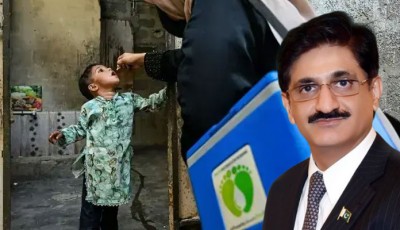

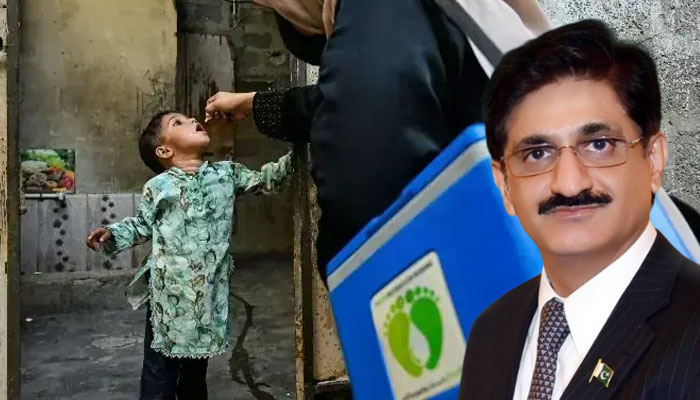
KARACHI: Sindh Chief Minister Syed Murad Ali Shah has directed authorities to intensify vaccination, surveillance and community engagement ahead of the September 21-27 Sub-National Immunisation Days (SNIDs), as the province reported a sharp decline in polio cases and virus circulation during 2026.
Chairing a meeting of the Provincial Task Force on Polio Eradication at the CM House on Wednesday, the chief minister noted that Sindh's polio burden had declined from 23 cases in 2024 and nine in 2025 to only one case so far in 2026.
“The progress achieved by Sindh is encouraging and reflects the hard work of our health workers, district administrations and partner organisations, but our mission will only be complete when every child is protected and the virus is eliminated from every district,” Murad Shah said.
He stressed that no child should remain unvaccinated because of negligence, weak supervision or inadequate follow-up.
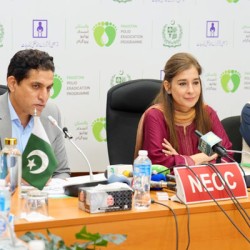
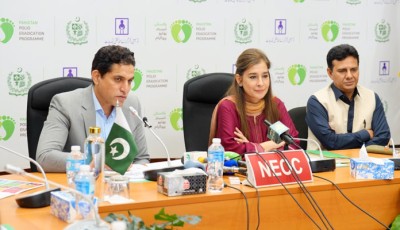
The meeting was attended by Sindh Health Minister Dr Azra Fazal Pechuho, Chief Secretary Asif Hyder Shah, Karachi Mayor Murtaza Wahab, IG Police Sindh Javed Alam Odho, Commissioner Karachi Hassan Naqvi, Provincial Coordinator Emergency Operations Centre (EOC) Shaharyar Gul, provincial secretaries, development partners and deputy commissioners. Commissioners, DIGs, deputy commissioners and SSPs from other districts participated through video link.
Briefing the meeting, Dr Azra Fazal Pechuho said Pakistan's wild poliovirus type 1 (WPV1) cases had declined from 74 in 2024 to 31 in 2025 and three so far in 2026. Sindh has recorded one case this year, reported from Sujawal on February 10.
EOC Coordinator Shaharyar Gul said environmental surveillance also indicated a significant contraction in virus circulation. Positive environmental surveillance sites in Sindh had fallen from a peak of 29 in March 2025 to five in August 2026.
All 14 surveillance sites outside Karachi were currently negative, while six of Karachi's 15 sites remained positive, suggesting that transmission was increasingly concentrated in limited pockets of the city.
Officials said the absence of confirmed polio cases in Karachi during the 2025 high-transmission season, despite some positive environmental samples, reflected stronger population immunity resulting from routine immunisation and repeated vaccination campaigns.
Chief Secretary Asif Hyder Shah said sustained immunisation efforts had helped prevent clinical cases even in areas where environmental surveillance continued to detect virus circulation.
The chief minister, however, stressed that even one polio case was one too many and directed commissioners, deputy commissioners and district health authorities to adopt zero tolerance towards missed children, refusals and operational gaps.
“Environmental samples are warning signals. We must act before the virus finds susceptible children,” he said.
Murad Shah ordered intensified vaccination and monitoring in Karachi and other identified high-risk areas, full implementation of the Karachi Action Plan 2.0, stronger coordination between district administrations and health authorities, closer monitoring of migrant and mobile populations, and improved routine immunisation coverage in underserved communities.
The meeting was informed that special booster campaigns conducted during 2026 delivered nearly three million oral polio vaccine doses and 2.89 million booster doses in Karachi. Campaigns in other divisions administered around 2.7 million OPV doses and 2.58 million booster doses. Expanded-age vaccination strategies also helped reach older children through schools and community-based interventions.
Reviewing efforts to reach missed children, officials said a special 10-day follow-up drive was conducted after the July 2026 SNIDs campaign. Of 146,149 children initially missed, more than 23,500 were subsequently vaccinated through targeted efforts focusing particularly on refusals and unavailable children.
The chief minister directed district administrations to further reduce refusals through stronger community engagement and public awareness, saying parents' trust remained critical to the eradication effort.
Preparations for the September 21-27 campaign were also reviewed. Nearly 10 million children under five are targeted for vaccination across Sindh. The campaign will cover 23 districts completely and selected union councils in seven other districts, with more than 80,000 frontline workers participating.
More than 26,000 police personnel have been assigned security duties for the campaign, while incentives for frontline workers have been increased by 28 per cent.
Murad Shah directed districts to complete vaccine supply, logistics, workforce deployment and supervision arrangements before the campaign begins.
Appreciating the work of frontline health workers, teachers, community mobilisers and staff serving remote and hard-to-reach communities, the chief minister described them as the backbone of the polio eradication programme.
“We have made substantial progress, but this is the most critical phase of the fight against polio,” Murad Shah said. “Every department, every district administration and every frontline worker must remain fully focused until transmission is stopped permanently. The upcoming September and December campaigns are vital, and no area must be left behind.”