
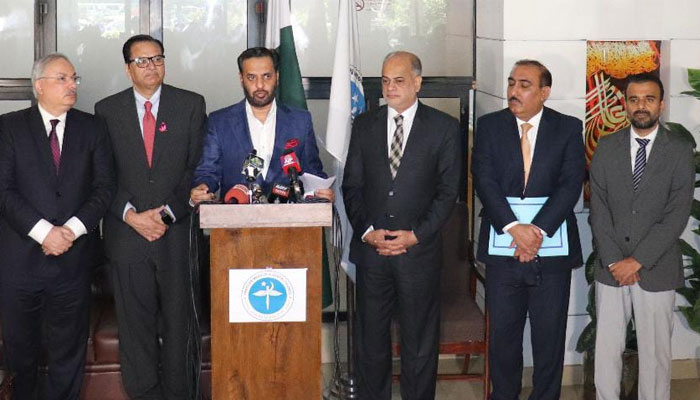
ISLAMABAD: Federal Minister for National Health Services, Regulations and Coordination, Syed Mustafa Kamal, has made it clear that universities — not the Pakistan Medical and Dental Council (PM&DC) — will be held accountable in case of paper leaks, mismanagement, or irregularities during the upcoming Medical and Dental College Admission Test (MDCAT) scheduled for October 26, 2025.
Addressing a press conference at the PM&DC head office in Islamabad, the minister urged all provincial authorities and universities to ensure a free, fair, and transparent examination across the country.
A total of 140,129 candidates have registered for the MDCAT this year, competing for 22,000 MBBS and BDS seats in public and private colleges nationwide. The test will be held at 32 venues, including one international center in Riyadh, Saudi Arabia.
The minister announced that the PM&DC had achieved a major milestone by developing a uniform national syllabus and an item bank containing more than 6,000 standardized questions. The syllabus was created in consultation with vice chancellors and education experts across Pakistan.
He said universities have prepared the test papers from this item bank “to their full satisfaction,” and any paper leakage or deviation from the approved syllabus will make the respective provincial university fully responsible.
To ensure transparency and efficiency, 50% of the allocated examination funds have already been released to all exam-conducting universities. The minister warned that the remaining 50% will be withheld if any misconduct, mismanagement, or paper leak is reported.
Under the new arrangement, public sector universities will conduct the MDCAT within their respective jurisdictions. They will handle all organizational, administrative, and logistical matters, including the exam process and result compilation, in accordance with PM&DC’s national framework and security protocols.
The PM&DC, however, will retain exclusive authority over candidate registration, policy oversight, and final result validation to maintain national uniformity and merit-based transparency.
Strict Exam Protocols and Security Measures
All participating universities have been directed to ensure:
Suitable exam centers with proper seating, ventilation, and drinking water.
Installation of mobile jammers to prevent use of electronic devices.
Walk-through gates and security checks at entry and exit points.
Deployment of trained invigilators and administrative staff.
Secure printing and confidential transfer of question papers.
Parent waiting areas and student verification counters.
Additionally, each university must conduct pre-hoc and post-hoc analyses to ensure no incorrect or out-of-syllabus questions are included.
According to the PM&DC, the MDCAT score will carry at least 50% weightage in medical college admissions. The score will be valid nationwide for three years and accepted by both public and private medical institutions.
The minister appreciated the PM&DC President, Registrar, and Examination Department for their efforts in creating a comprehensive, transparent system to ensure fairness in the MDCAT process.
“This strategic decision will ensure transparency, efficiency, and regional facilitation in MDCAT 2025,” Syed Mustafa Kamal concluded.