
ISLAMABAD: The issue of vacant seats in MBBS and BDS programmes has emerged as a major challenge for the current academic session, prompting the Pakistan Medical and Dental Council (PM&DC) to issue fresh guidelines aimed at addressing the situation in a fair and systematic manner.
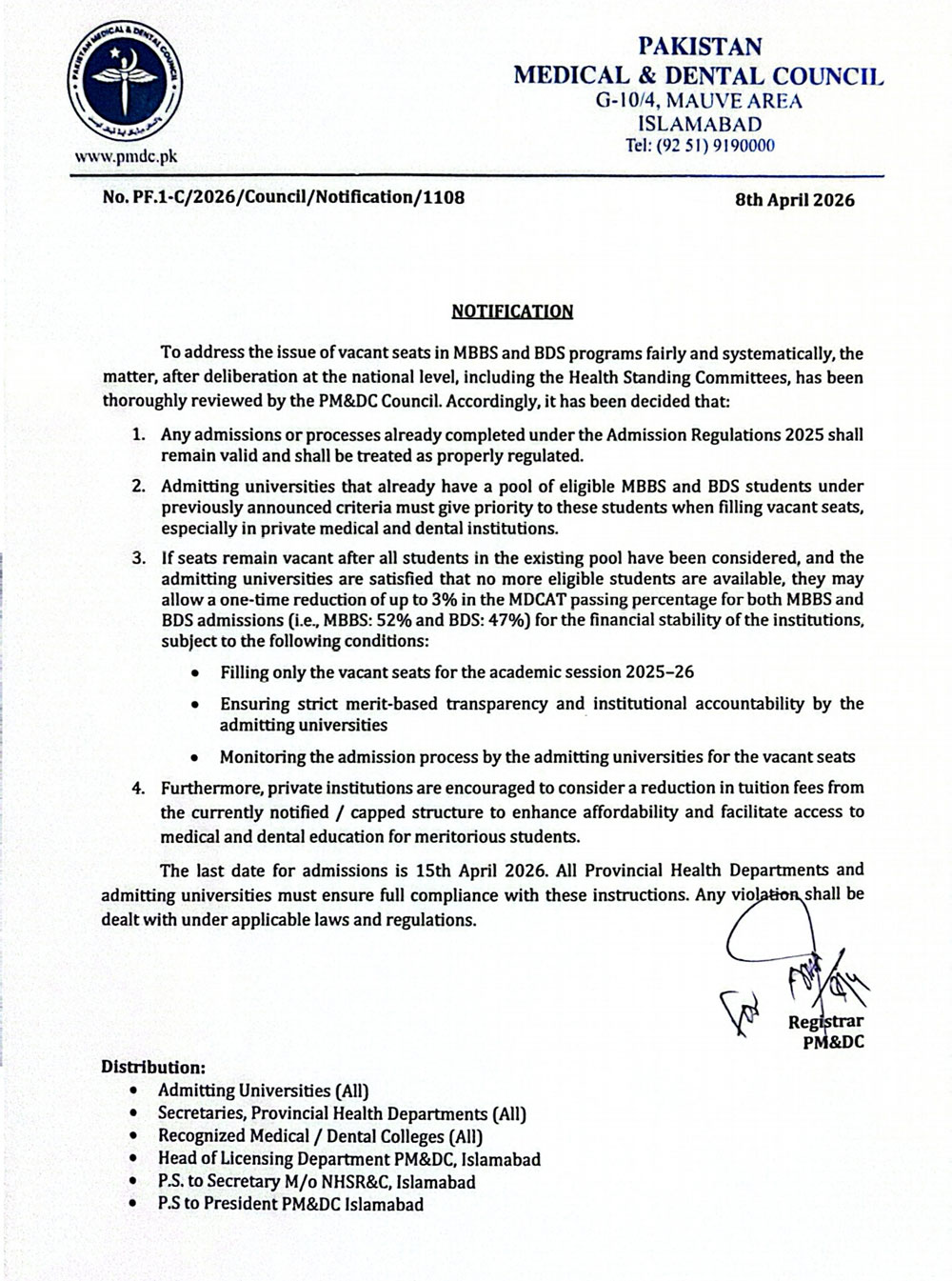
According to an official notification issued on April 8, 2026, the matter was reviewed at the national level, including deliberations by health standing committees, before final recommendations were approved by the PM&DC Council.
The council has clarified that all admissions already completed under the Admission Regulations 2025 will remain valid and fully recognized. Universities that already have a pool of eligible MBBS and BDS candidates under previously announced criteria have been directed to give priority to these students while filling vacant seats, particularly in private medical and dental colleges.
However, in cases where seats remain unfilled after exhausting the existing pool of eligible candidates, universities may allow a one-time relaxation of up to three percent in the MDCAT passing criteria. This would bring the minimum passing marks to 52 percent for MBBS and 47 percent for BDS admissions, subject to strict conditions.
The notification emphasizes that this relaxation is limited to filling only vacant seats for the academic session 2025–26, and must be implemented with transparency, merit-based selection, and institutional accountability. Universities have also been directed to closely monitor the admission process to ensure compliance.
In addition, private institutions have been encouraged to consider reducing tuition fees within the existing capped structure to improve affordability and facilitate access to medical and dental education for deserving students.
The PM&DC has set April 15, 2026, as the final deadline for admissions under these revised guidelines. Provincial health departments and admitting universities have been instructed to ensure full compliance, warning that any violations will be dealt with under applicable laws and regulations.
The development highlights growing concerns within the medical education sector, where vacant seats—particularly in private institutions—have raised questions about affordability, admission policies, and the overall accessibility of medical education in Pakistan.