
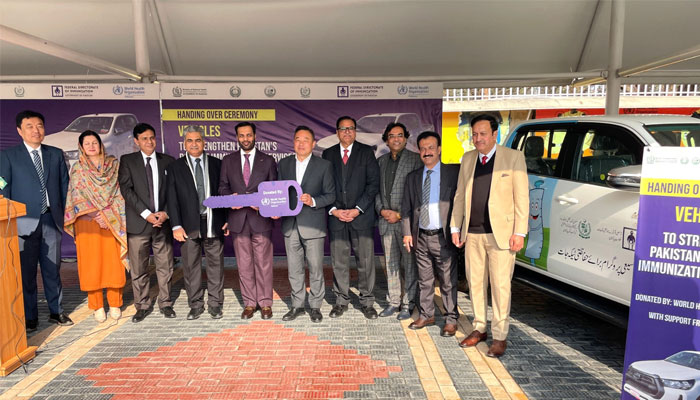
ISLAMABAD: The World Health Organization (WHO), with financial support from Gavi, the Vaccine Alliance, has handed over 20 four-wheel-drive (4x4) vehicles to Pakistan’s Expanded Programme on Immunization (EPI) to strengthen immunization services and supervisory activities in hard-to-reach and geographically challenging areas.
According to WHO, the vehicles will be deployed in 20 priority districts with a high concentration of “zero-dose” children—those who have never received any routine vaccination. The allocation includes three vehicles each for Sindh, Punjab, Khyber Pakhtunkhwa and Balochistan; two each for Pakistan-administered Kashmir (PAK), Gilgit-Baltistan and the federal level; and one each for the Capital Development Authority (CDA) and Islamabad Capital Territory (ICT).
Health officials said the new vehicles will help address longstanding transport shortages that have affected immunization performance in high-risk and remote districts. Improved mobility will enable managers and supervisors to directly monitor field activities, verify micro-plans, resolve on-site logistical issues and ensure vaccines reach distant communities.
Federal Health Minister Syed Mustafa Kamal, speaking at the handover ceremony, expressed gratitude to WHO and Gavi for their support. He said Pakistan faces serious challenges related to water, sanitation and health infrastructure, which increase disease risks for the population.
He emphasized that immunization against 13 vaccine-preventable diseases must remain a top priority, noting that prevention is more effective and economical than treatment. He added that the vehicles would help reach underprivileged communities and zero-dose children who lack access and awareness.
WHO Representative in Pakistan, Dr. Luo Dapeng, said reliable transport is essential for effective public health work. He stated that the vehicles will strengthen supportive supervision, improve problem-solving in the field and contribute to stronger immunization systems. He reaffirmed WHO’s commitment to partnering with Pakistan to protect every child from vaccine-preventable diseases.
Director General of the Federal Directorate of Immunization (FDI), Dr. Musa Khan, termed the initiative a significant step toward health systems strengthening. He said the vehicles will improve service delivery in hard-to-reach and security-challenged areas, ensuring that no child is left behind in immunization coverage.
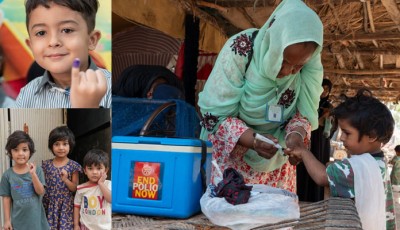
Pakistan launched its Expanded Programme on Immunization in 1978 in partnership with WHO. Each year, the programme vaccinates more than seven million children and around 5.5 million pregnant women against life-threatening diseases.
Globally, vaccination saves a life every ten seconds, and over the last 50 years, vaccines have saved an estimated 154 million lives worldwide.