
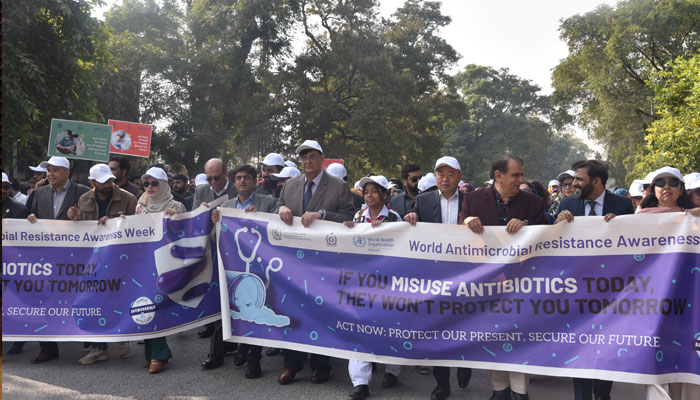
ISLAMABAD: Pakistan’s National Institute of Health (NIH) and the World Health Organization (WHO) jointly led an Antimicrobial Resistance Awareness Walk in Islamabad to mark the start of World Antimicrobial Awareness Week 2025, during which they announced the country’s first National Priority Pathogen List for antimicrobial resistance (AMR) in the Eastern Mediterranean Region.
The initiative aims to confront the growing threat of antimicrobial-resistant infections, which are responsible for over 200,000 directly attributable and associated deaths every year in Pakistan. Experts warn that without decisive action, AMR could cause 63,000 directly attributable deaths and 262,000 associated deaths annually by 2050.
NIH Chief Executive Officer Dr. Muhammad Salman said AMR demands a coordinated and comprehensive approach.
“Combating antimicrobial resistance requires a comprehensive One Health approach that addresses the interconnectedness of human, animal and environmental health,” he emphasized, citing irrational prescriptions, over-the-counter antibiotic sales, weak infection control, and misuse of antimicrobials in agriculture and livestock as major drivers of resistance.
WHO Representative in Pakistan Dr. Luo Dapeng noted that AMR is already claiming lives at an alarming rate.
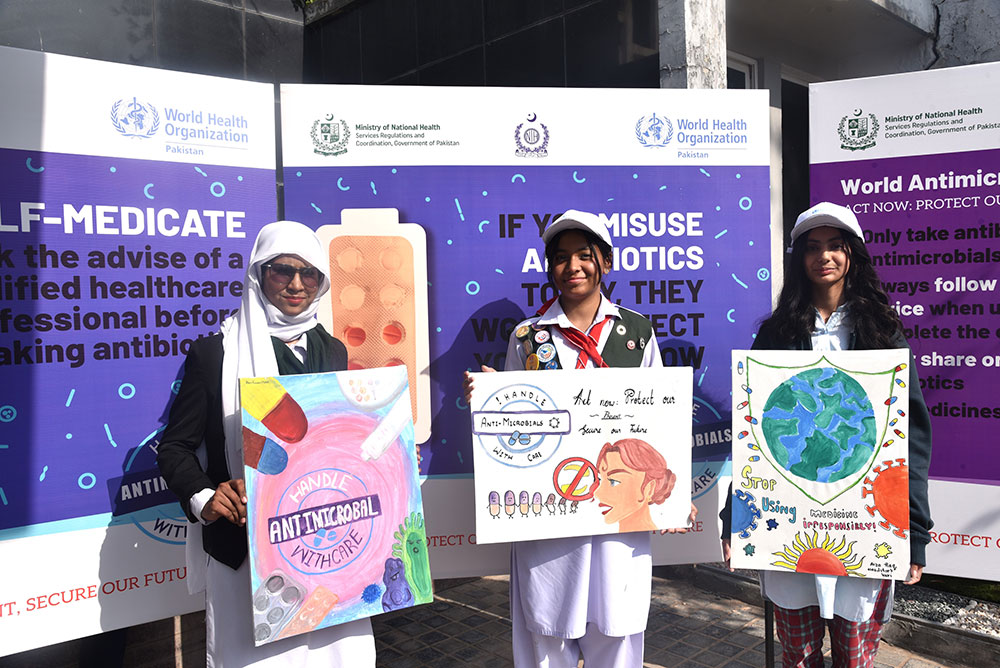
“Antimicrobial resistance is not a distant problem. It is happening now. As we speak, every five minutes, two people die due to antimicrobial resistance or associated reasons in Pakistan. These deaths are preventable,” he said, praising young students who used artwork during the event to highlight the importance of daily responsible action.
Globally, AMR could lead to 10 million deaths annually and a $100 trillion cumulative economic loss by 2050 if urgent measures are not implemented.
Pakistan’s National Priority Pathogen List is among the first eight such pathogen lists worldwide, representing a milestone achievement in efforts to protect health systems, food security, the environment, and the economy.
The awareness walk called for collective responsibility — urging policymakers, health professionals, farmers, community leaders, media, and the public to step up and act now to “protect our present and secure our future.”