
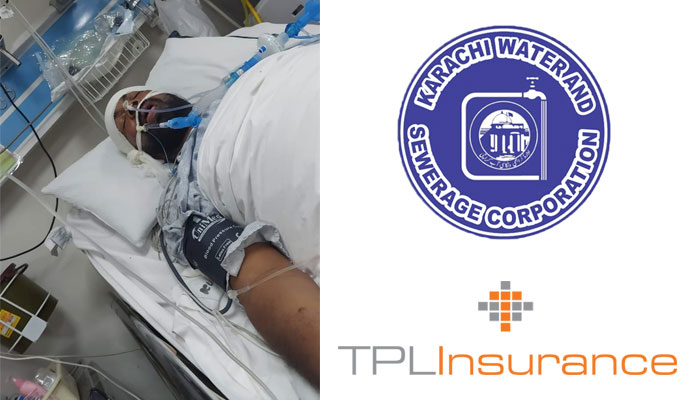
KARACHI: The medical crisis facing critically ill Karachi Water and Sewerage Corporation (KW&SC) employee Atiq Ahmed has intensified, with his family still seeking enhancement of his medical coverage while Saifee Hospital has formally requested that the approved amount be increased to Rs1 million for his treatment.
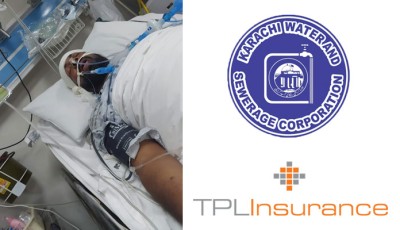
Atiq Ahmed, a naib qasid posted at New Karachi Tax, suffered a brain haemorrhage and was admitted to Saifee Hospital in North Nazimabad, where he remains critically ill. His case has raised serious questions about whether a fixed insurance limit can adequately protect an employee when treatment for a life-threatening illness must continue beyond the financial ceiling of the policy.
The latest correspondence reviewed by Health Matters Media shows that the hospital has sought further enhancement of the amount to Rs1,000,000.
In the email correspondence, TPL Insurance representative Muhammad Danish stated on September 28 that Atiq Ahmed's limit had been enhanced up to Rs700,000 as the "full and final limit." Saifee Hospital has now responded by requesting: "KINDLY ENHANCE AMOUNT RS: 1,000,000."
The development indicates that despite enhancement of the limit to Rs700,000, the financial requirement for Atiq's continuing treatment has gone beyond the amount currently approved, forcing the hospital and family to seek another increase while the patient remains critically ill.
This brings the central question surrounding the case into sharper focus: why should a critically ill employee face a financial ceiling while medically necessary treatment is still continuing?
For a patient suffering from a life-threatening condition, the need for treatment does not end when an insurance limit is exhausted. Atiq Ahmed's case raises the question of what mechanism exists to ensure uninterrupted treatment when the cost of ICU care, medicines, procedures and other hospital services exceeds the prescribed insurance coverage.
Irshad Ahmed Khan, Chairman of Muttahida Workers Front CBA, told Health Matters Media that Atiq remains in critical condition and that his family continues to struggle for enhancement of the medical limit.
According to Khan, the family has already faced demands for additional payment after the available coverage was exhausted and had earlier arranged and deposited Rs100,000 by borrowing money from others.
He also alleged that medicines required for Atiq's treatment had been affected after exhaustion of the available limit, while repeated requests had to be made for enhancement of coverage.
“The administration is not listening. We repeatedly have to keep requesting enhancement of the limit,” Khan said, questioning why an employee fighting for his life and his distressed family should have to repeatedly pursue financial approvals for continuation of treatment.
The latest Rs1 million enhancement request is particularly significant in light of the earlier position given to Health Matters Media by Director Medical Services KW&SC Faisal Qureshi.
Qureshi had previously said that KW&SC had approved an additional Rs250,000 from its medical pool for Atiq over and above his prescribed insurance coverage. He had also stated that further payment could be made depending upon the patient's medical requirements and that the hospital had been instructed to ensure there was no deficiency or negligence in his treatment.
However, the latest correspondence shows that the financial issue remains unresolved, with the hospital itself now seeking enhancement to Rs1 million.
The situation raises questions about whether the existing insurance and medical pool arrangements provide adequate protection in catastrophic medical emergencies and what happens when a critically ill employee exhausts the maximum amount available under the insurance policy but still requires hospitalisation and life-saving treatment.
It also raises questions over responsibility for costs beyond the insurance ceiling. If the insurer considers Rs700,000 the "full and final limit," will KW&SC cover the remaining medically necessary expenses from its own resources? What procedure exists for immediate approval in such emergencies? And can treatment continue without interruption while those approvals are being processed?
Khan has also cited the recent death of the wife of another KW&SC employee, Asif of Gulshan Tax, following illness, saying workers and their families are increasingly concerned about access to medical treatment under the existing arrangement.
KW&SC employees have previously protested over medical facilities and the outsourcing of health coverage. Workers demonstrated outside the Karachi Press Club in June and demanded restoration of the previous medical system while raising concerns over the insurance-based arrangement.
The fundamental issue highlighted by Atiq Ahmed's case is whether a critically ill employee should be left exposed to treatment limits at the very point when medical care is most urgently needed.
Health insurance policies ordinarily operate within contractual limits, but for KW&SC employees the question now confronting the corporation is what institutional safety net exists beyond those limits. If the insurance ceiling is exhausted while an employee remains in critical care, there needs to be clarity over how the remaining treatment will be financed and whether the employee and his family will be protected from having to arrange money themselves.
Atiq Ahmed's continuing battle for life therefore goes beyond an individual case. It raises the need for KW&SC and its insurance provider to clarify the total coverage available to employees, the procedure for enhancement in catastrophic cases, the responsibility for expenditure beyond the insurer's maximum limit, and the mechanism for ensuring that treatment and medicines are never interrupted merely because a financial ceiling has been reached.
Health Matters Media is seeking an updated response from KW&SC management, Director Medical Services Faisal Qureshi and the concerned insurance provider regarding the hospital's latest request to enhance Atiq Ahmed's limit to Rs1 million, the insurer's earlier description of Rs700,000 as the "full and final limit," and who will bear the cost of his continued treatment if the insurance limit has been exhausted.
Their responses will be incorporated upon receipt.